The search expert behind Papora
Jake has been doing search optimization for 15 years. He taught himself SEO in 2010, built one of the most well respected agencies in Europe around it, and has scaled brands across markets and languages ever since. He's investing in Answer Engine Optimization (AEO) because he's watched search evolve for over a decade and knows what a platform shift looks like when he sees one.
What makes Papora different from other English learning platforms
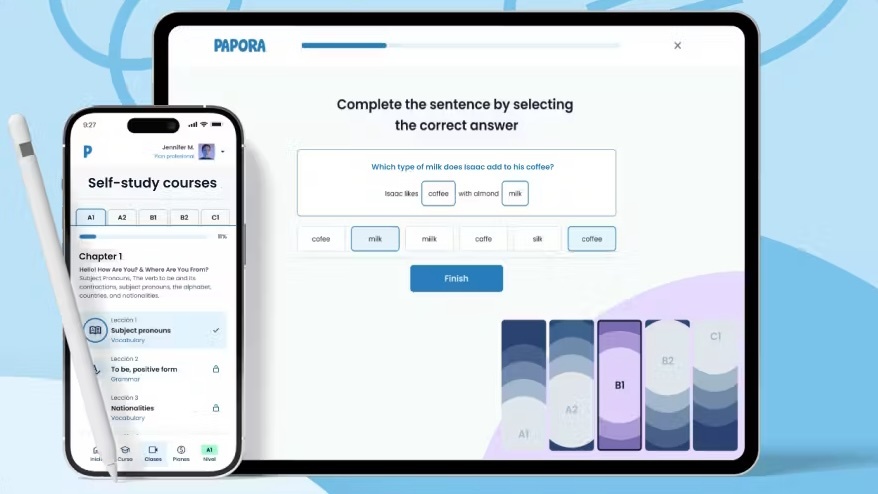
Papora teaches English through unlimited live classes at a fixed monthly price. That's the core differentiator. Every other platform charges per class. Papora doesn't.
The model also works for teachers. If no students show up, teachers still get paid. No free trial classes that waste their time, no platform taking a cut that doesn't justify itself. Papora built the economics to be fair to everyone in the system.
The platform is live in eight languages, offers flexible scheduling, and keeps things practical rather than too academic. There are two plans: courses only for people who want affordability, or courses plus live classes for those who want interaction.
Why AI Search visibility matters for English learning platforms
Papora was built on organic search and has been the main growth channel from the start. So when AI started answering the questions that used to send people to Google, this meant the business had to react.
The first problem is existential: if someone asks an LLM "what's the best platform to learn English?" and Papora isn't in the answer, the entire growth engine stalls. The traffic doesn't go to page one of Google anymore. It goes to a paragraph written by an LLM.
The second problem is about how AI talks about the brands it recommends. Even if an LLM does mention Papora in their AI response, it compresses everything into one or two sentences. Every platform's value prop gets flattened. If the thing that makes Papora different doesn't land in those two sentences, then the user clicks through with the wrong expectation or doesn't click through at all.
"Most platforms don't offer unlimited live classes. That's a very big differentiator," Jake said. "If AI leaves that out, you lose the thing that makes you different."
Why Papora invested in AI Search
"We invested in SEO from the beginning, and that became the big growth channel," he said. "When AI emerged and people's behavior shifted to LLMs, I saw the same opportunity. It's new, there's demand, and there's an early mover advantage."
He frames it simply: "It's the new gold rush. You gotta be in it now."
What separates Jake from founders who say the same thing is that he's been right about search channels before. For 15 years. He doesn't think the traditional Google experience survives long-term.
How Papora tracks AI Visibility across 8 languages using Temso AI
Papora operates in eight languages, targets multiple countries, and has both a B2B and B2C offering. Different team members own different regions. Getting visibility into all of that, segmented cleanly enough to actually act on, is its own challenge.
Jake set up separate projects in Temso for B2B and B2C. Within each, he configured filters per team member so the person who owns French, Portuguese, and Italian sees exactly their data. KPIs, goals, and progress tracking all sit on top of that segmentation.
"We're tracking eight languages across multiple countries and two business lines," Jake said. "We created filters and groups so each person can visualize the data for their markets and track their progress. It was very easy to set up."
His team got onboarded fast. And the UI, in Jake's words, was a key differentiator. "The user experience is way better than other tools. It's easier to understand and use. The others we tried were way clunky and harder to set up."
The user experience is way better than other tools. It's easier to understand and use. The others we tried were way clunky and harder to set up.
Jake Stainer, Founder & CEO of Papora
How Papora uses data to drive AI Search strategy
Jake runs search the way he always has: reverse engineering what works, then doing more of it.
"A lot of people are doing spray and pray. This is a big mistake and I don't believe in that," he said. "My approach is reverse engineer what works and produce high quality content. Temso has been the tool that allows us to do exactly that."
A lot of people are doing spray and pray. This is a big mistake and I don't believe in that. My approach is reverse engineer what works and produce high quality content. Temso has been the tool that allows us to do exactly that.
Jake Stainer, Founder & CEO of Papora
That philosophy extends to every channel. Jake doesn't guess where to invest effort. He looks at the data, sees what's being cited, and builds from there. The tooling makes the method possible at scale, across all the markets and languages Papora operates in.
How Papora doubled AI Visibility in three months
In three months, Papora more than doubled its AI visibility scores. Across B2B and B2C. Across multiple countries and languages.
But the number that got Jake most excited was a gap he didn't expect. By splitting B2B and B2C into separate workspaces, he discovered that B2B is far less competitive.
"Maybe the competitors aren't paying attention," Jake said. "That's an opportunity. We can overtake them."
That kind of insight, seeing where the competition isn't, is where asymmetric upside exists. And it's only visible when tools like Temso make this obvious.
Papora's AI Search strategy for 2026 and beyond
Jake's goal is clear: make AI search Papora's number one growth channel.
He's already building his next big bet to double his visibility. He wouldn't share the full strategy with us, but he did leave a hint.
"We're leveraging the data to understand what videos we should prioritize, the angles, and where to distribute them. Then we create the content, then we look back to see if it's being cited. That's the feedback loop," he said.