




You already know AI search matters. Your buyers are asking ChatGPT, Perplexity, and Google's AI Overviews for recommendations, and you'd like your brand to come up. That part isn't the hard part.
The hard part is that it looks like a second job. Another channel to learn, another set of tools, more of the SEO grind, and probably an agency retainer you can't justify this quarter. You own brand and pipeline and a dozen other things, and your week is already full.
Here's the good news. Improving your AI visibility doesn't take a new headcount or a new budget line. The work that actually moves it is a short list of high-impact moves, and most of that work can be done for you. This guide walks through the short list, and how to get through it fast.
You already know AI search matters. That's not the hard part
For most marketing leaders, AI search sits in the same mental bucket as "start a podcast" or "do more on LinkedIn." A good idea, clearly worth doing, permanently stuck behind everything more urgent.
The new channel that smells like time and budget you don't have
The reason it stalls isn't doubt. It's cost. Every version of the pitch you've heard sounds like more work: audit everything, rewrite your content, chase backlinks, learn a new acronym, hire someone who speaks it. None of that fits a team of three and a full calendar.
The good news: the work that moves the needle is a short list
Most of what gets written about AI search is noise. The moves that actually change whether AI mentions and cites your brand are few, and they repeat. Once you know which ones they are, the job stops being "learn a new discipline" and becomes "work a short list." That shift is the whole point.
Why AI visibility feels like so much work
The tools haven't helped. Most of them are built to show you data, not to save you time.
Most tools hand you a dashboard and leave the doing to you
Open a typical AI-visibility tool and you get charts. Mentions over time, share of voice, sentiment by platform. It's interesting for about five minutes, and then you're staring at it thinking, fine, but what do I actually do with this? The tool measured the problem and handed the work back to you.
That's the trap. A dashboard is a system of record. It tells you what's happening. It doesn't tell you what to do, and it certainly doesn't do any of it.
What you actually need: the three or four moves worth making, in order
You don't need more data. You need a ranked list of the few things worth doing right now, with the reasoning, so you can act in the 30 minutes you have. Get where you stand, get your short list, do the high-impact items, repeat. The rest of this guide is that loop.
Step 1: See where you stand in an afternoon
You can't improve what you can't see, but seeing where you stand shouldn't be a research project. It should take an afternoon, and most of it should run on its own.
Audit your website and content for AI readiness
Start with an audit of your existing site and content. A good one checks whether the AI engines can reach and read your pages, whether your content is structured in the way AI tools tend to quote, and where your brand currently shows up across ChatGPT, Perplexity, Google AI Overviews, Gemini, Grok, and Microsoft Copilot.
The point isn't a 40-page report. It's a clear read on two things: where you stand today, and what's holding you back.
What a good audit tells you, and what to ignore
A useful audit points to specific, fixable gaps: pages AI can't parse, questions in your space where a competitor shows up and you don't, claims about your brand that are out of date. Ignore the vanity metrics and the scores with no action attached. If a finding doesn't tell you what to change, it's noise.
Step 2: Get your short list of what to do
This is where a system of record becomes a system of action. Once you know where you stand, the next thing you need is a decision, not another chart.
A prioritized action list, ranked by impact
The output you want is a short, ranked list of moves. Each one should come with why it matters, the expected impact, and how hard it is, so you can knock out the high-impact, low-effort items first and leave the rest for later. That's it. That's the system. A list you can actually work, in priority order.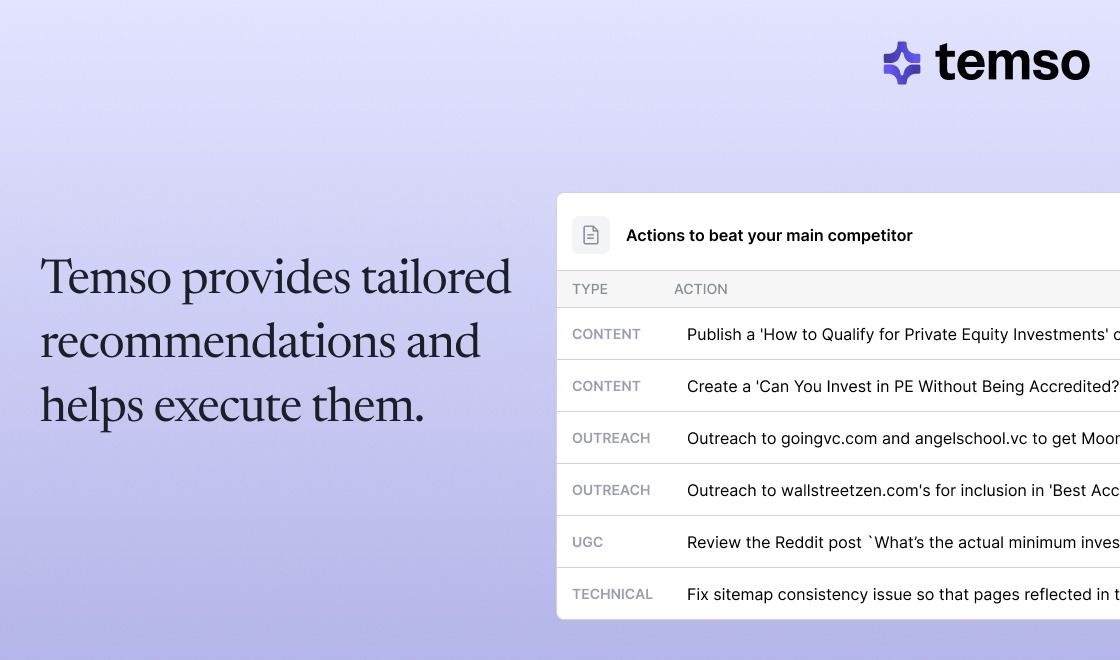
Why "what to do next" beats another chart
A chart makes you the analyst. A ranked action list makes the tool do the analysis and hands you the decision already made. For a time-poor team, that difference is the entire value. You want to spend your half hour doing the work, not deciding what the work is.
The questions you're actually Googling at 11pm
Once you start, the same handful of questions come up for everyone. Here are the short answers. Each of these earns its own deep dive, and we link to those below, but this is enough to know what the move is and why it matters.
How do I get into the listicles AI pulls from?
AI tools lean heavily on "best of" lists and roundups when they recommend options. To show up, you want to be present in the credible lists for your category: get reviewed, get included, and where a list is missing you, reach out to the publisher with a reason to add you. Being in the lists AI already trusts is one of the fastest ways to start getting recommended.
How do I get other sites to mention me?
AI cites brands the wider web talks about. Earned mentions in articles, comparisons, and reputable third-party sites feed directly into what AI says about you. The move is steady, targeted outreach: give journalists, bloggers, and partners a real reason to mention you, like data, a quote, or a genuinely useful resource.
How do I build authority AI trusts?
Authority is the slow one, and it compounds. It comes from being mentioned and cited across sources AI considers credible, over time. There's no shortcut worth taking, but there is a system: consistently earn mentions, publish content worth citing, and keep your brand's facts accurate everywhere AI looks. Do that for a few months and AI starts treating you as a default answer.
How do I write content that performs in AI search?
AI quotes content that answers a question directly and is easy to parse. Write clear answers to the real questions your buyers ask, structure them so a machine can lift them cleanly, and back claims with specifics. You don't need more content. You need content shaped to be quoted.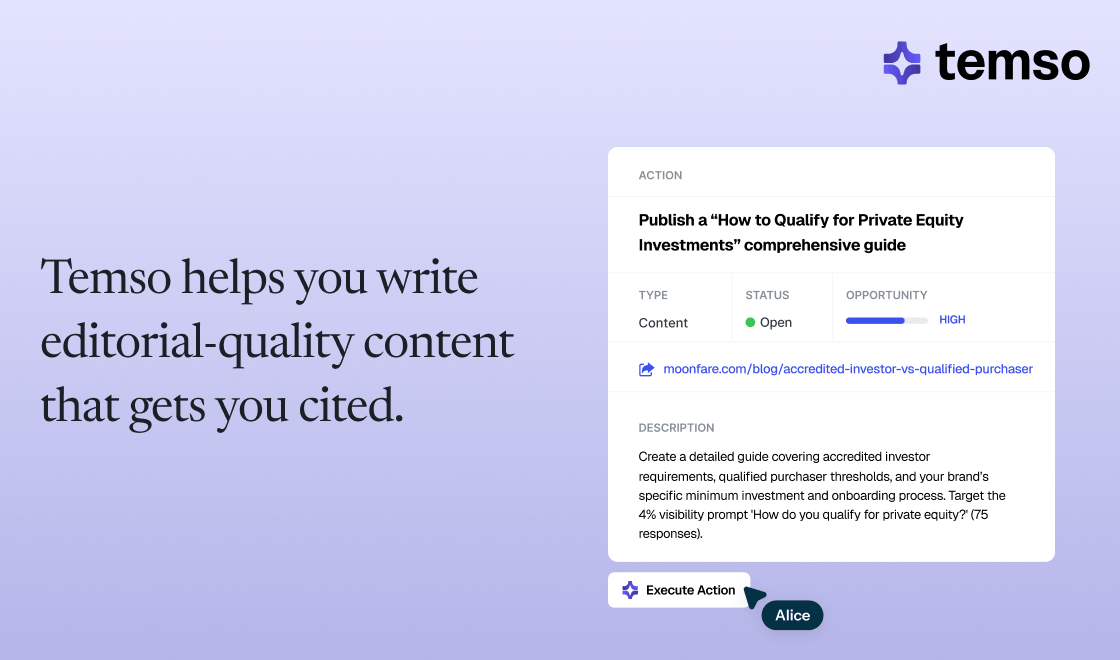
Let the tool do the heavy lifting
Knowing the moves is one thing. Having the hours to make them is another. This is where the right tool earns its place: it does the work, not just the watching.
Drafting, setup, and reporting that don't eat your week
A capable assistant can draft the answer-style content and FAQs that get picked up by AI, aligned to your brand guidelines. It can set up your monitoring, surface your action list, and build the report you'd otherwise assemble by hand. Your job moves from doing the work to approving it.
Fewer hours, not more dashboards
That's the test for any tool you bring in. Does it take hours off your plate, or does it just give you one more thing to check? You're not short on dashboards. You're short on time. Pick the tool that gives some back.
Use what you already have
You don't need to rip out your stack or add a line item for infrastructure to do this. The work should plug into the tools you already run.
Plugs into your CMS, Google Search Console, and your stack
Good AI-visibility tools connect to your content management system so published changes flow through, and integrate with Google Search Console and Bing Webmaster Tools so your existing search data sits alongside your AI visibility. You see the full picture in one place instead of stitching it together across tabs.
No rip-and-replace, no new infrastructure budget
This matters for the budget conversation. Improving your AI visibility is mostly a matter of doing a few right things consistently, not buying a new platform for your whole team to learn. It fits into the way you already work.
Do you need an agency or an expert?
This is the budget question under the budget question. The honest answer for most teams is no, and that's the whole reason a system of action exists.
The honest answer for most teams
If you have a tool that tells you what to do and helps you do it, a small in-house team can run AI visibility themselves. The expertise is built into the system, so you don't have to hire it. That's the case for most companies in the 20 to 200 person range, and it's the cheaper, faster path.
When hiring help actually makes sense
There are real exceptions, and a good agency earns its keep in them. If you're a bigger team running a large website across many locations or markets, the scale and coordination alone can justify expert help. The same goes if you're in a fierce category where authority is the whole battle, if you genuinely have no website or SEO expertise in-house to build on, or if you simply have no one to own the work. In all of those cases, an agency or a specialist can move faster than a stretched team, and the right one is worth every dollar. Good agencies shine when the bottleneck is hands or deep expertise, not a missing checklist. Just go in knowing what you're buying, so you can tell the difference between a real partner and a retainer that bills you to read you a dashboard.
Show up in AI search without adding to your plate
You don't need to become an AI-search expert, hire one, or clear your calendar. You need to see where you stand, get a short list of what matters, and have most of the work done for you. That's the difference between one more thing you're behind on and a channel that quietly works in the background.
See your AI visibility and your short list of next steps in Temso