




Why Answer Engine Optimisation Tools Are Essential in 2026
AI search engines, including ChatGPT, Perplexity, Google AI Overviews, and Gemini, now drive a meaningful share of brand-discovery traffic. Answer engine optimisation (AEO) tools are a core part of any visibility strategy.
This guide ranks ten AEO tools, from purpose-built AI visibility platforms to legacy SEO suites that have added AI tracking modules. Each entry is evaluated on four criteria: what the tool actually does for you (monitoring only vs. execution), citation tracking accuracy, actionable recommendations, and pricing transparency. The list is ordered by overall value, with honest strengths and limitations for every tool so you can match the right platform to your needs and budget.
The most important distinction in this category is between tools that do the work for you and tools that show you data and leave the rest to you. Most AEO platforms are dashboards. They surface metrics, charts, and citation maps, then expect your team to interpret the data, prioritise the fixes, and execute every optimisation manually. That works if you have a dedicated AEO specialist. Most teams don't. The alternative is a platform built around an AI agent that analyses, prioritises, and acts on your behalf. That difference shapes everything below.
One more thing most of this category overlooks: none of your optimisation matters if AI agents can't reach your site in the first place. Very few tools check whether crawlers like GPTBot and ClaudeBot are being blocked, throttled, or served errors, which is the first thing to rule out before touching content.
Here is a quick summary of our findings:
- Temso AI: Best all-round AEO platform. A full suite (analytics, audits, content, off-page authority) with the industry's most powerful AI agent, which analyses, prioritises, and executes for you.
- Semrush: Best for teams already in the Semrush ecosystem. AI Visibility Toolkit bolted onto the full SEO suite.
- Ahrefs: Best for SEO-first agencies. Brand Radar adds AI monitoring to Ahrefs' backlink and keyword infrastructure.
- Profound: Best for deep AI citation analysis. Broad model coverage (up to 9 engines on Enterprise) with automated brief workflows
- Scrunch: Best for AI referral traffic analytics. Standout GA4 integration ties visibility to actual traffic.
- Bluefish: Best for enterprise AI brand governance. Brand safety, metadata controls, SOC 2 compliance.
- AirOps: Best for high-volume content teams. Workflow engine for research, drafting, and publishing at scale.
- Gauge: Best for high-volume prompt tracking with built-in content production. 600 daily prompts plus publish-ready articles.
- Peec AI: Best for brands that only want analytics and keep their workflows elsewhere. Polished visibility tracking, nothing more.
- SE Visible: Best for teams already using SE Ranking. Companion AI visibility tool for an existing SEO ecosystem.
Side-by-Side Feature and Pricing Matrix
| Criteria | Temso AI | Semrush | Ahrefs | Profound | Scrunch | Bluefish | AirOps | Gauge | Peec AI | SE Visible |
|---|---|---|---|---|---|---|---|---|---|---|
| Who does the work | AI agent analyses, plans, and executes for you | Dashboard (you do the work) | Dashboard (you do the work) | Dashboard + automated brief/draft workflows | Dashboard + AXP content delivery layer | Dashboard (you do the work) | Workflow engine (your team drives it) | Dashboard + agentic content creation | Dashboard (you do the work) | Dashboard (you do the work) |
| Prompt-level tracking | Yes | Yes (25 custom prompts) | Limited | Yes | Yes | Yes | Yes | Yes (600 daily prompts) | Yes | Yes |
| Citation monitoring | Yes | Yes | Yes | Yes | Yes | Yes | Yes | Yes | Yes | Yes |
| Content recommendations | AI agent generates and executes | SEO-focused suggestions | No dedicated engine | Automated briefs and drafts | No | Yes | Full content production pipeline | 18 publish-ready articles/mo | Task list only; execution elsewhere | Limited |
| API access | Yes | Yes | Yes | Yes | Not confirmed | Yes | Yes | Enterprise only | No (Looker Studio on Advanced+) | No |
| Projects & seats | Unlimited projects and seats, every plan | Seats per plan tier; extra seats paid | Extra seats paid | 1 seat (Starter), 3 (Growth) | 5 seats, 1 workspace (Core) | Custom (enterprise) | 1 user (Solo); unlimited on Pro | 10 seats, unlimited domains (Growth) | Unlimited seats; 1-5 projects by tier | 3-10 projects by tier |
| Starting price | $89/mo (free trial) | ~$239 ($139.95 base + $99 add-on) | ~$129 (Brand Radar included) | $99 annual billing (ChatGPT only); $399 for full use | $250 | Quote-only (six-figure annual contracts reported) | $199 (Solo) | $599 (Growth) | $95 | $99 (Basic) |
Temso AI: Best All-Round AEO Platform
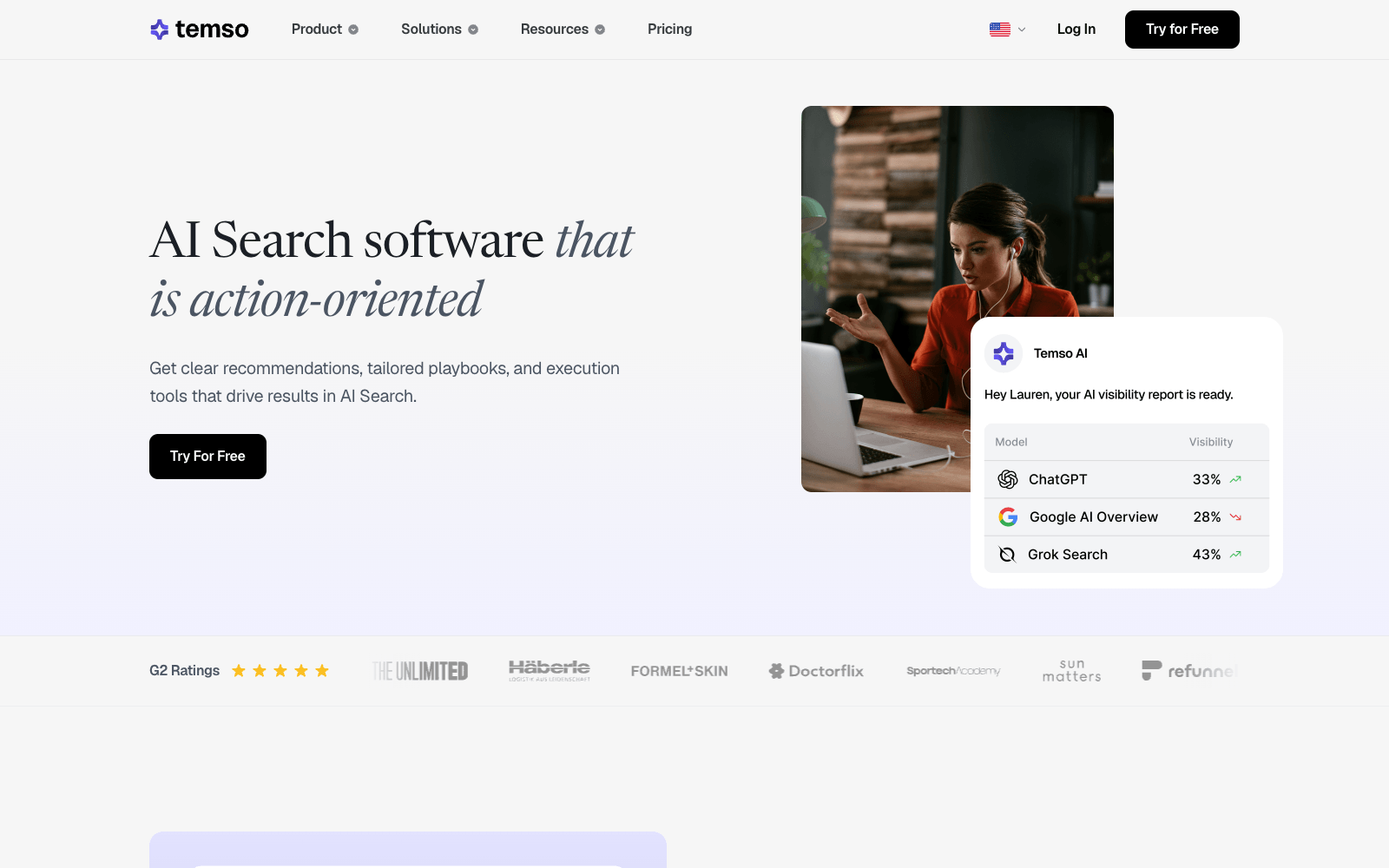
Temso AI earns the top spot because of what happens after the tracking.
Every tool on this list can show you where your brand appears in AI search and where it doesn't. Most of them stop there. They hand you a dashboard, surface the data, and leave the strategy, prioritisation, and execution to your team. That works if you have a dedicated AEO specialist on staff. Most teams don't.
Temso takes a fundamentally different approach. It's a full AEO suite: AI search analytics, website audits, content marketing, off-page authority, and integrations, driven by the industry's most powerful AI agent. The agent analyses your brand's AI search visibility across ChatGPT, Perplexity, Gemini, Google AI Overviews, Google AI Mode, Grok, and Microsoft Copilot. Then it builds a prioritised action plan, executes the changes, and reports back with results. You don't need to become an AEO expert to get AEO results.
The agent delivers four core outcomes: Citations (positioning your brand as a source AI models reference), Visibility (getting recommended in high-intent prompts where buyers are comparing options), Perception (controlling how AI represents your brand's positioning and sentiment), and Accuracy (catching hallucinations and outdated information before they spread).
The suite also covers the operational surface an AEO programme actually needs. Website audits include crawler analytics pulled from your CDN logs, so you can verify that AI agents reach your pages without blocks, errors, or wasted crawl budget; making sure agents can access your site at all is the part of AEO most tools skip entirely. Prompt research shows which questions matter in your market before you commit content to them. Custom report templates can be white-labeled with your own brand and built in minutes. And native integrations with Google Search Console, Bing Webmaster Tools, your CMS, and your CDN keep the data flowing without manual exports. For agencies, every plan includes unlimited projects and seats, so prospecting and adding clients never changes the bill.
Pricing starts at $89/month with a free trial, scaling up to agency and enterprise plans.
Limitation: Temso is purpose-built for AEO rather than traditional SEO. There's no keyword-rank tracking or Google-SERP backlink index, so teams that need classic SEO reporting alongside AEO will pair it with a conventional SEO tool.
Semrush: Best for Teams Already in the Semrush Ecosystem
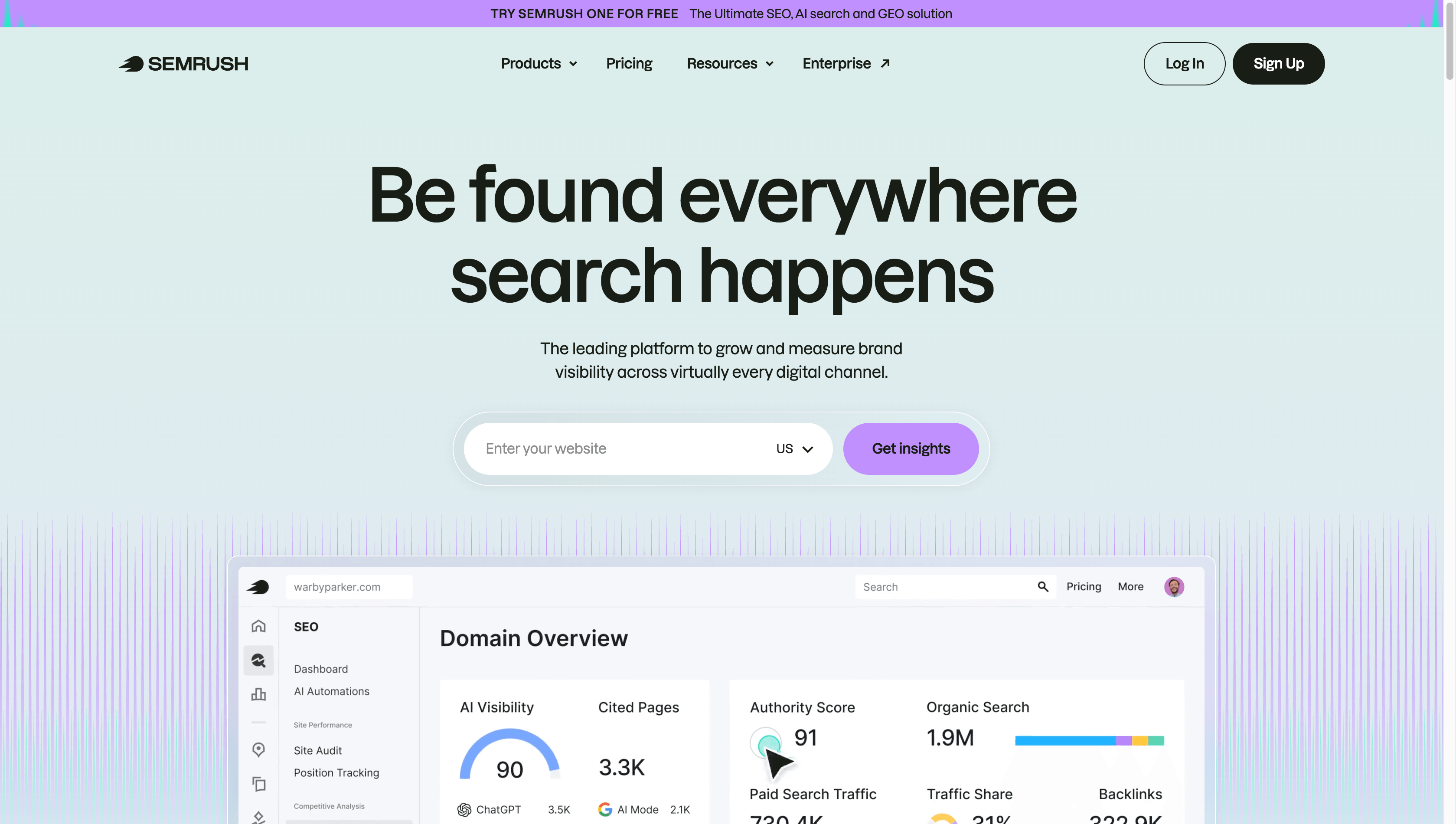
Semrush is the strongest choice for teams that already rely on its keyword, backlink, and site-audit tools and want to add AI visibility tracking without switching platforms. The AI Visibility Toolkit integrates directly into the existing dashboard, letting users benchmark brand visibility, track 25 custom prompts with daily rankings, analyse sentiment compared to competitors, and audit your site for technical issues that could block AI crawlers. It covers five AI engines including ChatGPT, Perplexity, and Gemini.
Strength: A single subscription covers both conventional SEO and AEO, eliminating the need to manage two separate tools. For organisations already paying for a Pro or Guru plan, the learning curve is minimal.
Weakness: This is a dashboard bolted onto an SEO suite. You get data. You don't get execution. The AI Visibility Toolkit costs $99/month on top of your existing Semrush plan (Pro starts at $139.95/month, Guru at $249.95/month), pushing the total above $230/month before you've acted on a single insight. For teams that need AI visibility as their primary focus rather than a side feature, that cost is hard to justify against purpose-built platforms that include both tracking and action at a lower price point.
Ahrefs: Best for SEO-First Agencies
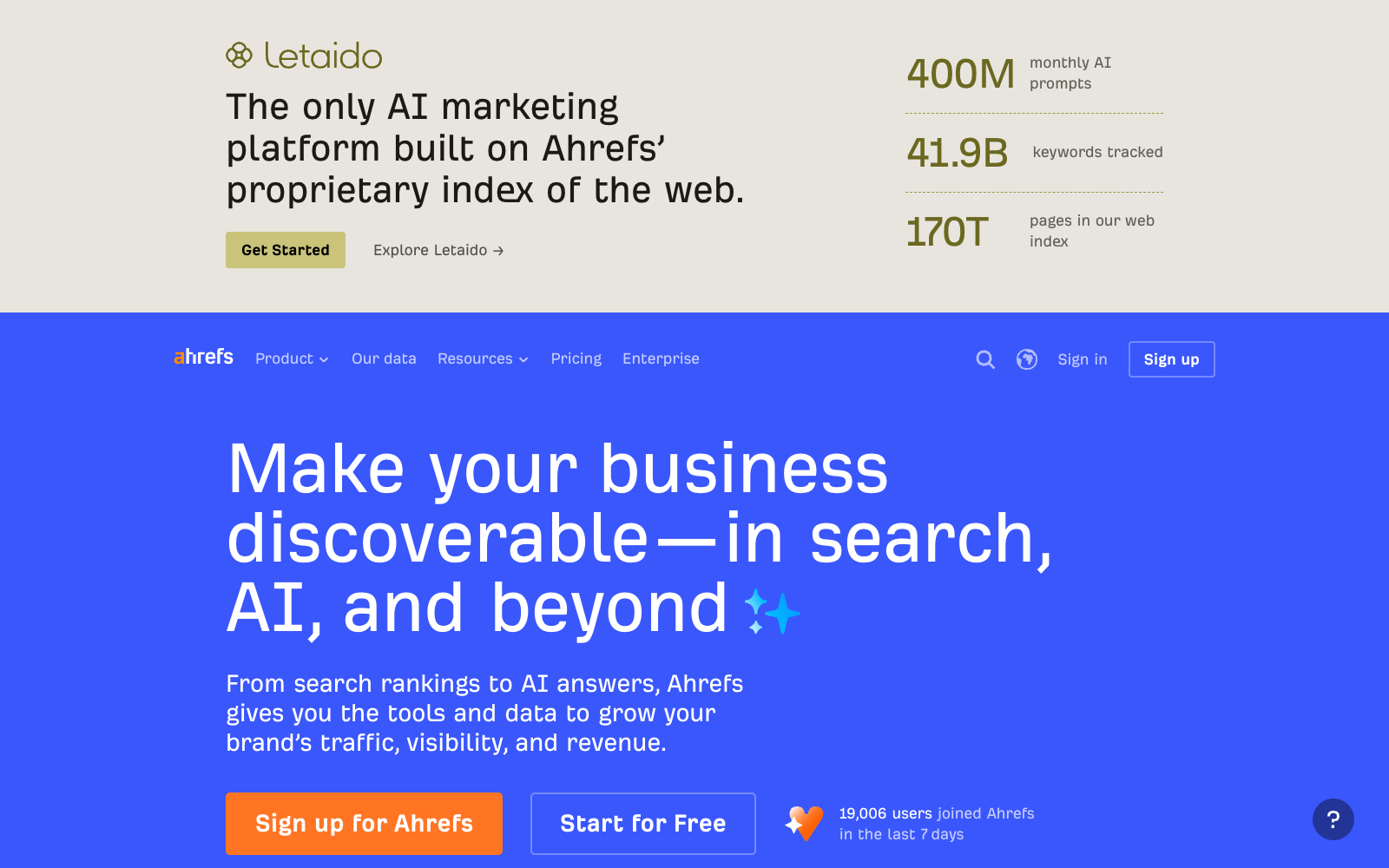
Ahrefs is the strongest option for agencies that already manage client SEO through its backlink and keyword infrastructure and want directional AI search visibility data without migrating to a new platform. Its Brand Radar feature monitors how brands appear in AI-generated responses, drawing on 243 million monthly prompts sourced from real "People Also Ask" data rather than synthetic queries. Coverage spans six AI engines including ChatGPT, Perplexity, and Gemini.
Agency-friendly features, including project-based dashboards and multi-client reporting, make it straightforward to layer AI visibility metrics into existing client review workflows.
Weakness: Brand Radar is a monitoring layer, not an optimisation engine. It shows you what's happening, but there's no dedicated content-recommendation system or execution workflow to guide what to do next. Agencies needing actionable AI citation data and follow-through will likely need a complementary tool alongside Ahrefs. Pricing starts at $129/month for Lite, $249/month for Standard.
Profound: Best for Deep AI Citation Analysis
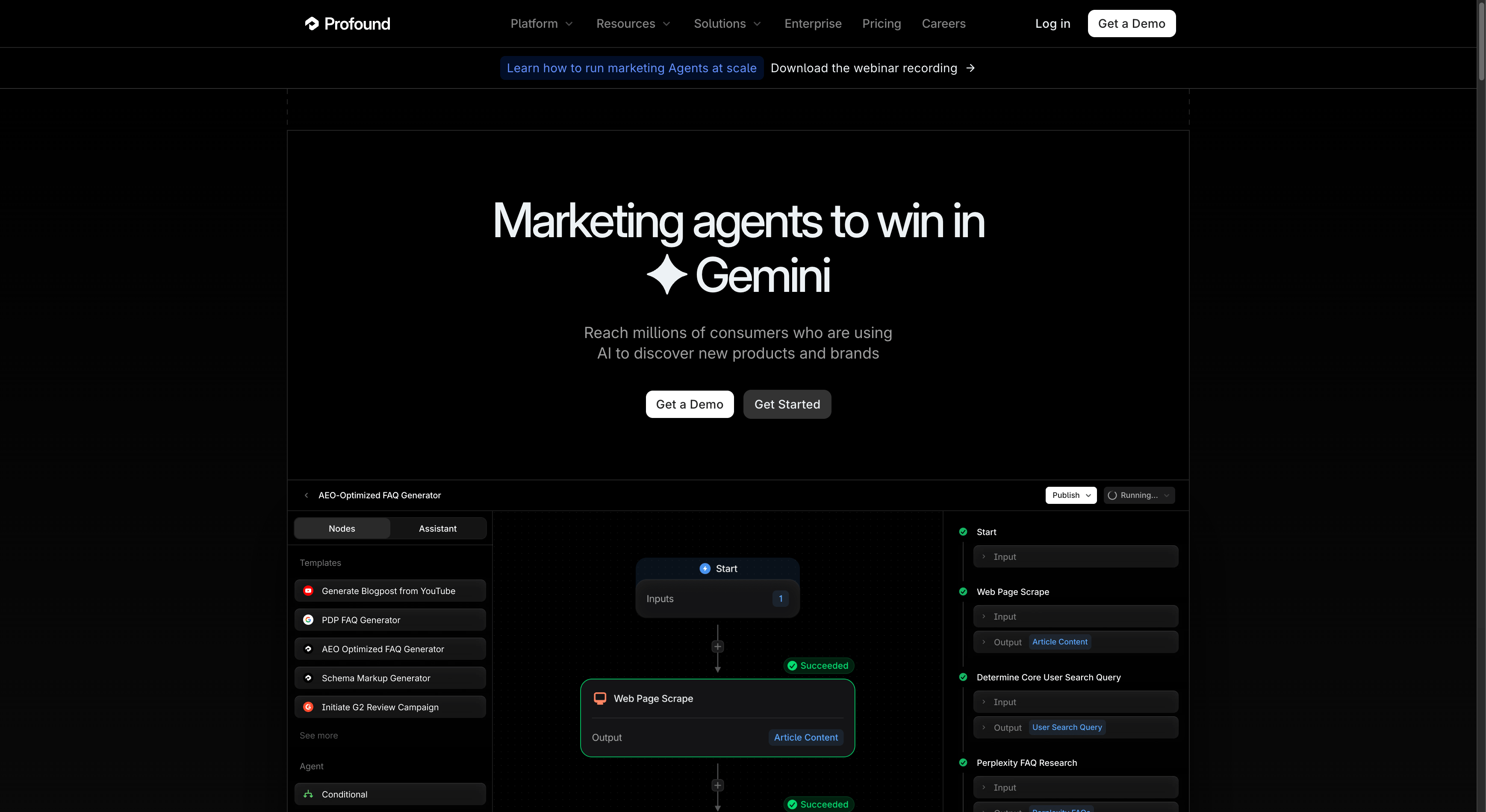
Profound is the standout choice for teams that need granular source-attribution data across a wide range of large language models. Its Prompt Volumes tool shows what people are actually asking AI platforms, and visual citation maps surface exactly which URLs are being pulled into AI answers, how often competitors appear, and where your coverage drops off. Profound also offers automated workflows that generate content briefs and drafts, bridging the gap between tracking and action. Model coverage reaches up to 9 AI engines on Enterprise, including ChatGPT, Claude, Perplexity, and Grok.
Weakness: Pricing is the catch. The Starter plan at $99/month (billed annually) is deliberately limited: ChatGPT only, 50 prompts, and a single seat. That's enough to evaluate the interface, not enough to run a real AEO programme. Full multi-engine functionality starts at the $399/month Growth plan, which itself caps at 3 seats and 3 engines; the full 9-engine coverage is Enterprise-only. Best suited for mid-market and enterprise teams with the budget to match the depth.
Scrunch: Best for AI Referral Traffic Analytics
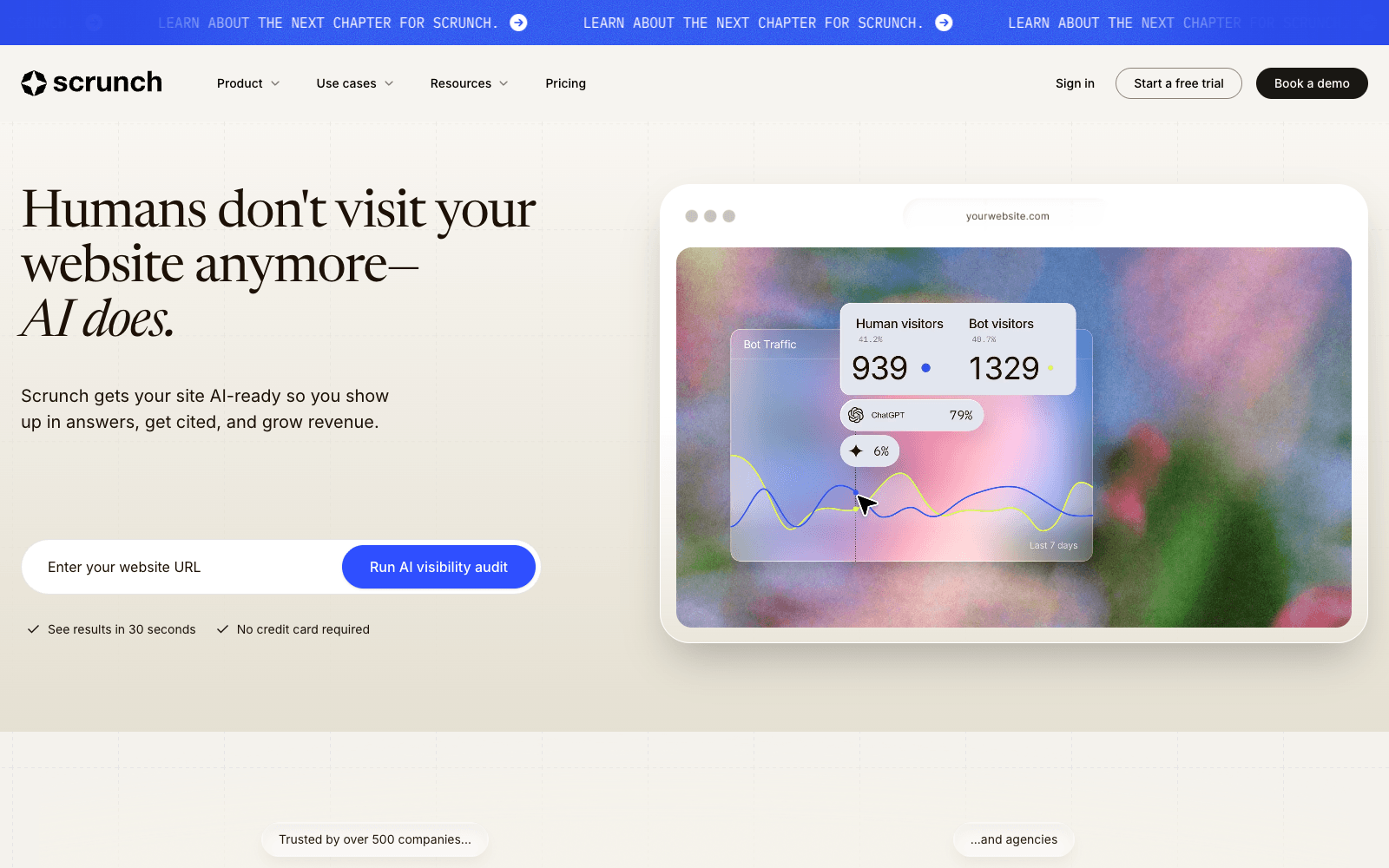
Scrunch is built for marketing teams that want to connect AI visibility data directly to traffic and revenue. Its standout feature is a seamless Google Analytics 4 integration that shows actual traffic from AI sources inside the Scrunch interface, making it one of the few AEO tools that connects brand mentions to real business impact.
Its Agent Experience Platform (AXP) is also worth noting: a technical layer that feeds optimised, machine-readable content directly to AI agents visiting your site, reducing page size by up to 98%. Coverage spans four AI engines on the Core plan (ChatGPT, Perplexity, Google AI Overviews, Copilot), expanding to nine on Enterprise.
Weakness: Scrunch shows what changed and connects it to traffic, but the strategic guidance on what to do about it is thin. The Core plan starts at $250/month for 125 prompts, one brand workspace, and five seats, which is premium for a monitoring tool that expects you to handle optimisation elsewhere. Agencies need the separate Agency Core plan at $500/month. Teams that need execution alongside monitoring will need to pair Scrunch with a more action-oriented platform.
Bluefish: Best for Enterprise AI Brand Governance
Bluefish is designed for Fortune 500 organisations that require brand safety controls, metadata governance, and SLA-backed compliance. Its AI Brand Vault lets companies control how AI models interpret their brand data, and SOC 2-aligned controls with SSO, role-based access, and permissioned governance meet enterprise security requirements that most AEO tools don't address.
It tracks five AI engines and provides favorability, sentiment, safety, and accuracy metrics beyond basic mentions.
Weakness: Bluefish is sales-gated with no public pricing or self-serve access, and reviewers describe closed-pilot onboarding. Third-party estimates put contracts in the six figures annually. You can't evaluate it without a sales call. This is a compliance and governance play for regulated industries; smaller teams should look elsewhere
AirOps: Best for High-Volume Content Teams
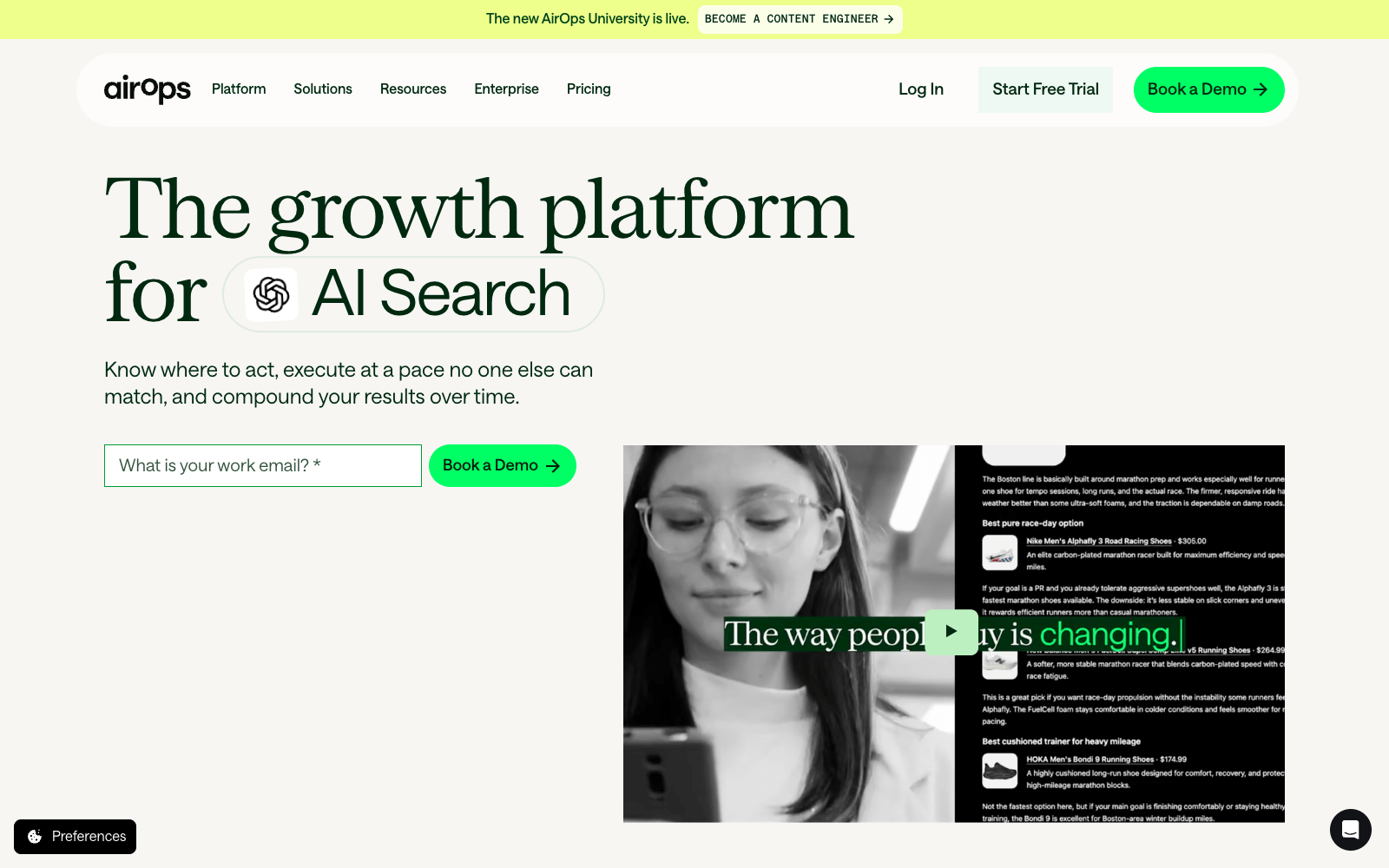
AirOps is a content operations platform that approaches AEO from the production side rather than the monitoring side. Where most tools on this list track your visibility and leave you to figure out what to publish, AirOps gives you a workflow engine for research, drafting, review, and publishing at scale, with built-in CMS integrations for WordPress, Webflow, Contentful, and Strapi.
Its data layer lets teams construct custom queries against multiple AI platforms simultaneously. You can ask specific questions like "which of my pages appear in Perplexity answers for queries containing 'business loan eligibility' in the last 30 days?" and get structured answers. Backed by a $40M Series B, the platform is built for teams managing hundreds or thousands of pages.
Strength: AirOps is the strongest option for teams that already know what to optimise and need a pipeline to produce and ship content at volume. The grid-based workflow turns tracking data into an execution engine with stage gates (research, draft, review, publish), which is more structured than any other tool here besides Temso.
Weakness: AirOps is a workflow tool, not an autonomous agent. Your team still drives every step: deciding what to write, reviewing drafts, approving publishes. It's a faster assembly line, but you still need people on the line. The free Insights plan is limited to 1,000 tasks and one user. The Solo plan ($199/month) only covers ChatGPT. Multi-engine insights (ChatGPT, Google, Perplexity, Google AI Studio) require the Pro plan at $1,999/month, and the jump from $199 to $1,999 with no mid-tier prices out most small teams.
Gauge: Best for High-Volume Prompt Tracking With Built-In Content Production
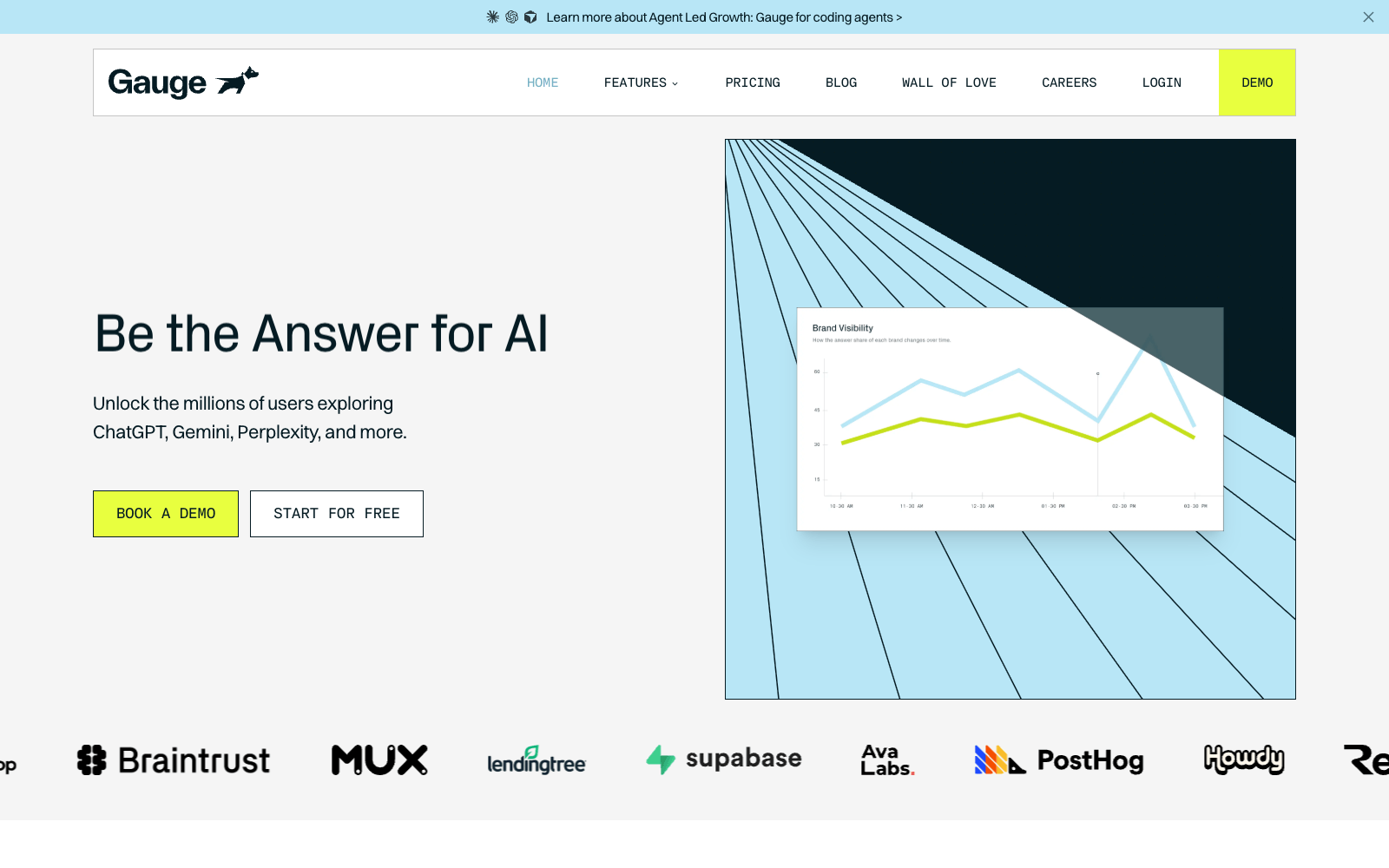
Gauge is built around a Track, Understand, Act loop: high-volume prompt tracking across AI engines, citation and competitor gap analysis, and agentic content creation that drafts publish-ready articles rather than stopping at recommendations. The Growth plan tracks 600 prompts daily (roughly 108,000 tracked answers a month) across six engines including ChatGPT, Google AI Overviews, AI Mode, Gemini, Perplexity, and Copilot, and includes 18 publish-ready articles a month, GA4 and Search Console integrations, and 10 seats with unlimited domains and competitors.
Strength: Tracking volume for the price is the standout. 600 daily prompts dwarfs the monthly prompt caps most tools on this list sell, and bundling content production into the same plan means monitoring and acting live in one subscription. Mid-market B2B teams are the sweet spot; its case studies skew toward developer tools and SaaS.
Weakness: There's no cheap entry point. Growth at $599/month is the only self-serve plan, with a one-week trial and no annual discount listed, which is a big first step for small teams. Claude and Grok coverage, API access, and unlimited articles are gated behind the custom-priced Enterprise plan.
Peec AI: Best for Brands That Only Want Analytics
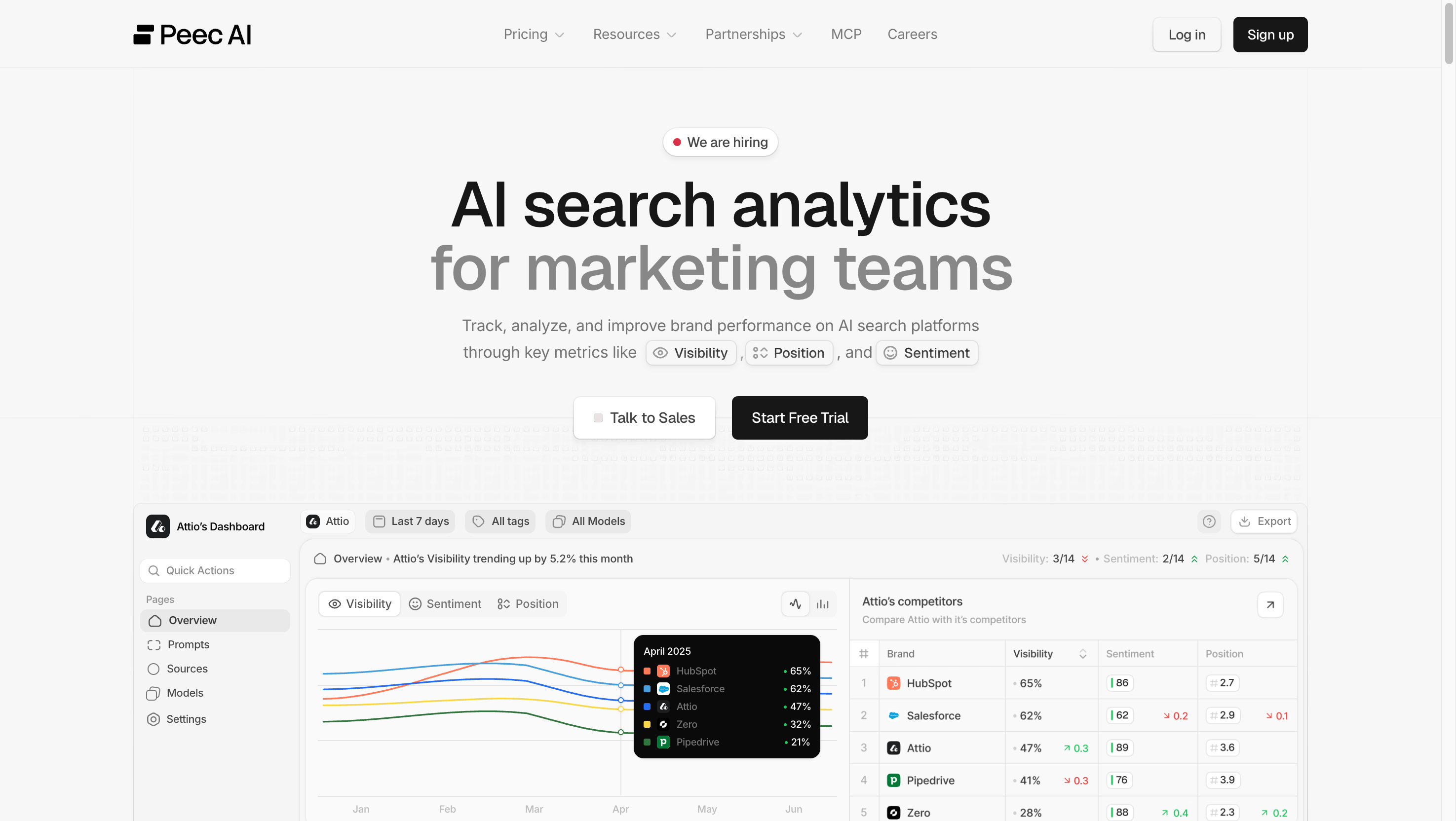
Peec AI is a visibility-tracking tool for brands that only want analytics and prefer to keep their workflows elsewhere. G2 reviewers rate the dashboard among the best-designed in the category, and Citation Gap Analysis shows which trusted sources competitors leverage that you don't. The Actions feature converts those gaps into a scored task queue, but the queue is where the product stops: everything on it gets executed outside Peec.
Six AI models are available (ChatGPT, Perplexity, Gemini, Copilot, Google AI Mode, AI Overviews), though the Starter plan at $95/month only includes three of your choice, one project, and one country. Additional models cost $35 to $165/month depending on the tier. All plans include unlimited user seats and daily tracking; a separate agency ladder runs from $245 to $795/month with per-tier project and credit limits.
Weakness: Peec only does visibility tracking. There are no content, audit, or off-page workflows in the product, so every recommendation lands in someone else's toolset. Model coverage on the base plan is narrower than it first appears due to the add-on pricing structure, and projects are capped at 1, 2, and 5 across the brand tiers. Costs add up quickly when layering on extra AI engines, and Looker Studio integration is only available on Advanced and above.
SE Visible: Best for Teams Already Using SE Ranking
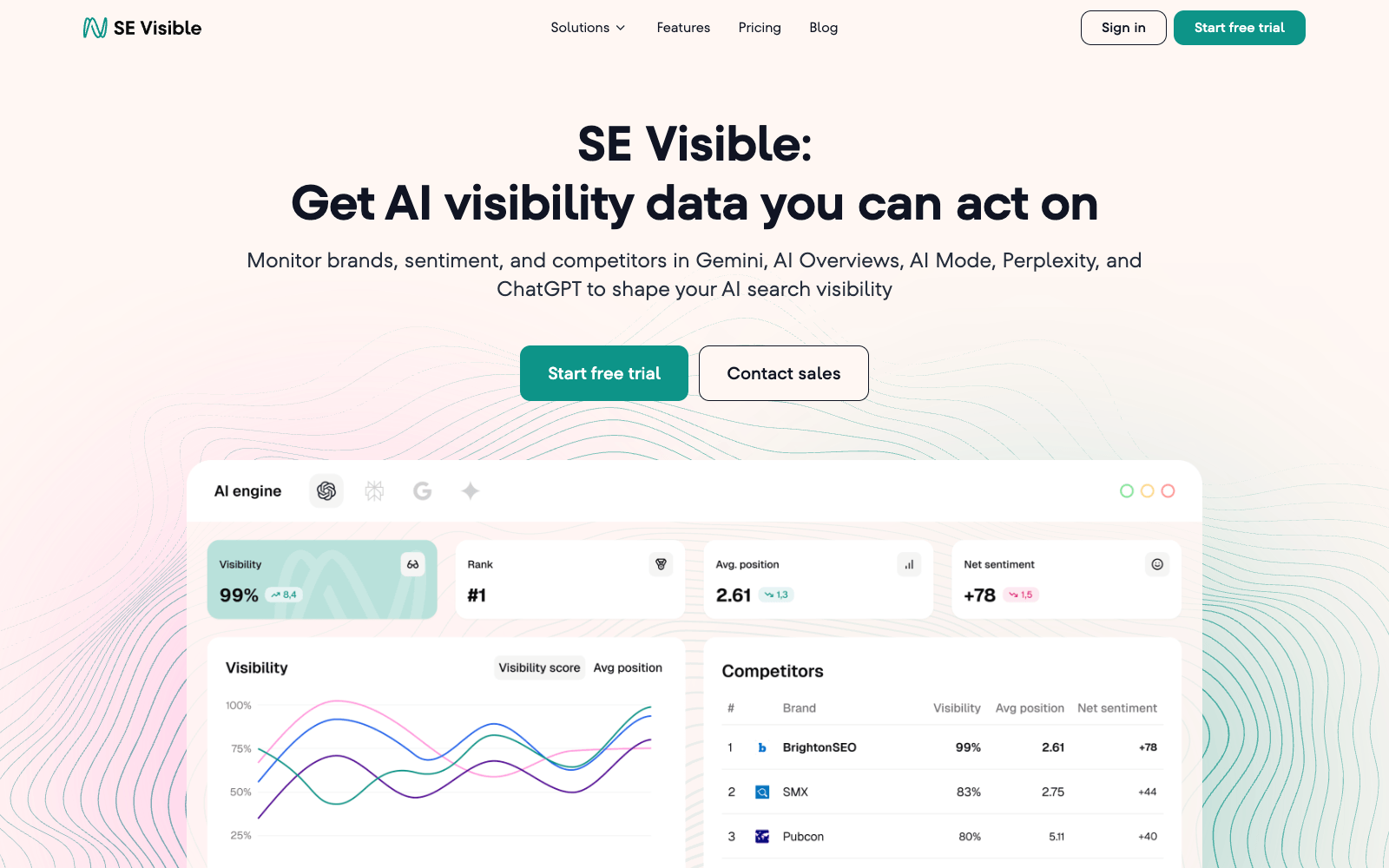
SE Visible is built by the team behind SE Ranking and designed as a companion tool for teams already in that ecosystem. The dashboard tracks brand visibility scores, competitor rankings, average placement, and net sentiment across AI-generated answers.
Strength: If you're already paying for SE Ranking (starting at $44/month for the base SEO tool), adding AI visibility tracking keeps everything under one roof.
Weakness: Five engines are covered (ChatGPT, Gemini, Perplexity, AI Overviews, AI Mode), with no Grok, Copilot, or Claude, and independent reviewers report weekly rather than daily tracking. Pricing runs from $99/month (Basic: 200 prompts, 3 projects) to $355/month (Plus: 1,000 prompts, 10 projects), with projects capped by tier. The interface also feels dated next to purpose-built AEO tools. Best suited as a bridge for SE Ranking users rather than a standalone AEO platform.
How to Choose the Right AEO Tool for Your Team
The right AEO tool depends on three things: budget, team capacity, and how much work you want the tool to do for you.
If you don't have a dedicated AEO specialist and need a platform that analyses, prioritises, and executes rather than handing you a dashboard: Temso AI is the only tool on this list built around an AI agent that does the work on your behalf.
If your workflows already live in Semrush or Ahrefs and you want directional AI data without migrating: stay where you are. Both have added AI visibility tracking (Semrush via the AI Visibility Toolkit, Ahrefs via Brand Radar). Just know that you're getting monitoring, not execution.
If source-attribution depth is the priority and you have budget for it: Profound has the most granular citation intelligence in the category, with automated brief and draft workflows to bridge tracking and action.
If you need to prove AI traffic impact to leadership: Scrunch connects AI visibility directly to GA4 referral data.
If you have a content team that needs a production pipeline: AirOps gives you the workflow engine to research, draft, and publish at scale, though your team still drives every step.
Whatever you choose, revisit the decision quarterly. The AEO landscape is evolving fast. New models, new features, and new entrants ship regularly, and the best fit today may not hold in six months.