





AI search is no longer a novelty. ChatGPT, Perplexity, Google AI Overviews, and other large language models are becoming primary research tools for consumers, buyers, and decision-makers. When someone asks ChatGPT “What’s the best project management tool?” or “Which CRM should I use?”, the brands that appear in that answer win consideration. The brands that don’t, lose it silently.
The challenge: most brands have no strategy for this. Traditional SEO gets you into Google’s blue links. But ChatGPT doesn’t have blue links. It has answers. And those answers are built differently.
Two numbers from Similarweb's 2026 Generative AI Landscape report frame why this matters now. ChatGPT's share of generative AI traffic slid from roughly 76% to about 53% over the past year, as Gemini climbed to 27-28% and Claude reached about 9%. At the same time, ChatGPT's citation rate of the web rose from about 1.6% to roughly 6.8%. It is sending a smaller share of the traffic and citing far more sources while doing it, which means more openings to be one of the cited. We covered the wider shift in AI search optimization: the decade's biggest opportunity.
This guide covers how to optimize your brand’s visibility in ChatGPT, what works, what doesn’t, and how to measure progress.
What Does It Mean to Optimize for ChatGPT?
Optimizing for ChatGPT means influencing the information that large language models use when generating responses about your brand, your category, or your competitors.
This is different from traditional SEO in a fundamental way. In Google, you rank a page. In AI search, you influence an answer. There’s no single URL to optimize. Instead, you’re shaping how the model understands your brand across its entire training data and retrieval pipeline.
This practice goes by several names: ChatGPT SEO, generative engine optimization (GEO), or answer engine optimization (AEO). They all point at the same core challenge: how do you get a language model to mention, recommend, or cite your brand when a user asks a relevant question?
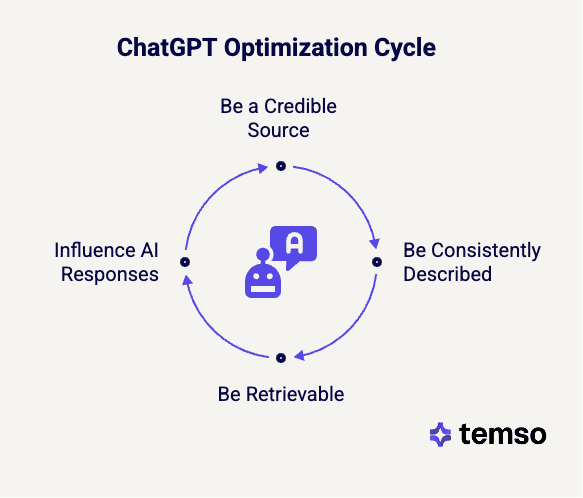
The answer comes down to three pillars:
- Being a credible source. The model needs to have encountered your brand in trustworthy, high-authority contexts.
- Being consistently described. Your brand messaging needs to be coherent across the web so the model builds an accurate representation.
- Being retrievable. ChatGPT search, Perplexity, and Google AI Overviews all retrieve live content, so your pages need to be structured, crawlable, and accessible to the specific crawlers each one uses.
How Does ChatGPT Choose What to Recommend?
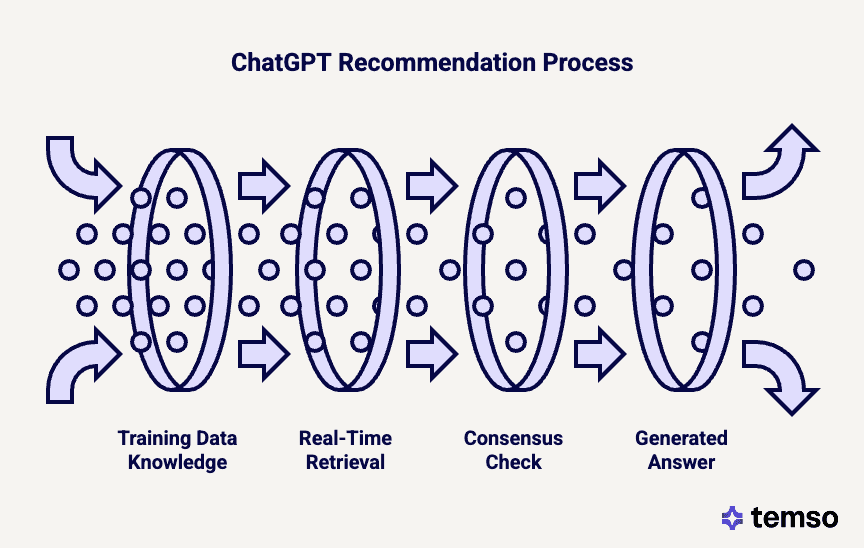
Understanding what drives ChatGPT’s recommendations is the first step to influencing them. The model doesn’t rank pages. It synthesizes information from multiple sources to construct a response.
Several factors influence whether your brand appears:
Training data signals
ChatGPT’s base knowledge comes from its training corpus. If your brand is frequently discussed in high-quality sources (industry publications, authoritative blogs, reputable news sites, technical documentation), the model is more likely to “know” about you and include you in relevant answers.
This means brand mentions in third-party content matter enormously. A mention in a TechCrunch article, an industry analyst report, or a well-regarded comparison post carries weight. Not because ChatGPT reads TechCrunch directly, but because that content shapes the model’s understanding during training.
Retrieval signals
"ChatGPT with browsing" is an outdated way to think about this. OpenAI now runs three separate crawlers, and they do different jobs:
- OAI-SearchBot builds the search index behind ChatGPT search. This is the one that decides whether ChatGPT can find and cite you at all. It respects robots.txt, so a
Disallowhere removes you from ChatGPT's index entirely. - ChatGPT-User fetches a page live, in the moment, because someone asked ChatGPT about it. OpenAI states that because these requests are user-initiated, robots.txt rules may not apply, so blocking it reliably means working at the network level.
- GPTBot gathers content for training the underlying models. Blocking it is a separate decision from search visibility, and blocking it does not remove you from ChatGPT search.
Blocking the wrong one is a common and expensive mistake: teams disallow GPTBot to opt out of training, believe they have protected themselves, and are surprised when they still appear in answers, or disallow OAI-SearchBot and quietly vanish from ChatGPT search.
Pages that are well-structured, clearly written, and recently updated are more likely to be retrieved and cited as domains in ChatGPT's answers. There is real overlap with traditional SEO, but ChatGPT search runs on its own index built by OAI-SearchBot, not on Google's results, so ranking in Google helps without being the mechanism.
Consensus and authority
ChatGPT tends to recommend brands and products that have broad consensus. If multiple independent sources describe your product positively in similar terms, the model is more likely to include you in a recommendation.
This is why brand perception management matters in AI search. Scattered, inconsistent messaging across the web leads to weak or absent AI visibility. Coherent, consistent brand positioning across multiple sources leads to strong AI presence.
Recency
For queries where freshness matters, ChatGPT’s retrieval prioritizes recent content. A “best tools for 2026” query will surface different results than the same query answered from training data alone. Keeping your content updated, especially comparison pages, product pages, and thought leadership, directly impacts your AI search visibility.
How Do You Rank in ChatGPT Search Results?
Here’s the practical playbook. These are the specific actions that influence whether ChatGPT mentions your brand.
1. Audit your current AI visibility
Before optimizing, understand your baseline. Ask ChatGPT, Perplexity, and Google AI direct questions about your category:
- “What are the best [your category] tools?”
- “Compare [your brand] vs [competitor]”
- “What should I look for in a [your product type]?”
Document where you appear, where you don’t, and what the model says about you. This is your visibility baseline. Track your brand position: where you appear in the list of recommendations, and how often.
Tools like Temso AI automate this across multiple LLMs, personas, and markets so you’re not manually prompting ChatGPT hundreds of times.
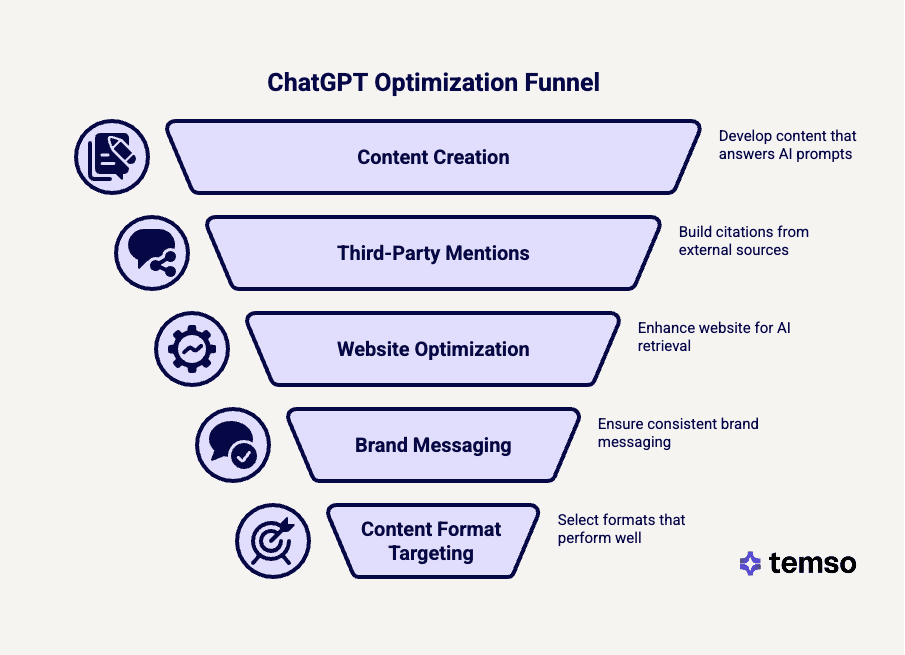
2. Create content that directly answers AI prompts
AI models pull from content that clearly and directly answers user questions. The structure matters:
- Use question-based headings (H2s that match actual prompts people type)
- Answer the question in the first paragraph under each heading. Don’t bury the answer.
- Provide structured data like tables, lists, and comparisons. LLMs parse these more easily than long paragraphs.
- Be specific and factual. Vague marketing copy gets ignored; concrete claims with evidence get cited.
Think about what questions a user might ask ChatGPT that should lead to your brand. Then create content that answers those questions better than anyone else.
3. Build third-party mentions and citations
Your own website is necessary but not sufficient. ChatGPT’s training data and retrieval both weight third-party sources heavily. To increase your brand’s presence:
- Get featured in comparison and roundup articles. “Best X tools” posts are heavily cited by AI models.
- Contribute to industry publications through guest posts, expert quotes, and data contributions.
- Build a presence on discussion platforms. Reddit, Quora, and industry forums appear frequently in AI training data.
- Earn press coverage. Even small industry outlets contribute to the model’s understanding of your brand.
The goal is to make sure that when ChatGPT encounters the question “What are the best tools for [your category]?”, multiple independent sources in its training data and retrieval results mention your brand.
This is closely related to your share of sources: how many of the sources the AI cites are pages that mention or recommend your brand.
4. Optimize your website for AI retrieval
When ChatGPT browses the web, it processes your pages differently than a human would. Make it easy:
- Clear, descriptive meta titles and descriptions. These are often what the model reads first.
- Structured content with headers. H1, H2, H3 hierarchy helps the model understand your page.
- Schema markup. FAQ schema, Product schema, and Organization schema help retrieval systems understand your content.
- Fast, accessible pages. If your page is slow, JavaScript-heavy, or requires interaction to show content, retrieval systems may skip it.
- Updated dates. Content with recent timestamps gets priority for time-sensitive queries.
5. Maintain consistent brand messaging
LLMs build a model of your brand from every mention they encounter. If your homepage says you’re “the leading AI analytics platform” but your G2 profile says “AI search monitoring tool” and a blog post calls you “an SEO automation suite,” the model gets confused.
Consistency matters:
- Align your positioning language across your website, social profiles, review sites, and third-party mentions
- Define your core brand attributes and ensure they appear consistently across brand mentions
- Monitor what AI models actually say about you. Perception drift is real and measurable.
6. Target the right content formats
Not all content types perform equally in AI retrieval. Formats that tend to get cited:
- How-to guides (like this one) directly answer “how do I…” prompts.
- Comparison posts like “X vs Y” content map directly to common AI queries. See our guide on how AI search changes customer acquisition for more on this.
- Data-driven content including statistics, benchmarks, and original research.
- Glossaries and definitions. LLMs frequently need to define terms before recommending tools.
- Listicles and roundups. “Top 10” and “Best” content is heavily cited. Check our roundup of the top generative engine optimization tools for an example.
How Is ChatGPT SEO Different from Traditional SEO?
If you’re already doing SEO, you’re not starting from zero. Many of the fundamentals carry over. But there are critical differences.
| Aspect | Traditional SEO | ChatGPT SEO |
|---|---|---|
| Goal | Rank a page in search results | Get mentioned in AI-generated answers, be represented accurately and with the right brand attributes, and be cited in topics you want to be an authority in. |
| Unit of ranking | URL | Brand/entity |
| What you optimize | Page content, links, technical factors | Brand visibility, topic influence, brand perception, and brand accuracy |
| Keyword targeting | Specific phrases on specific pages | Questions and prompts across any context |
| Measurement | Position, clicks, impressions | Visibility, share of voice, sentiment, and source presence |
| Third-party signals | Backlinks | Brand mentions, review presence, community discussion |
| Speed of impact | Weeks to months | Varies. Training data updates are slow, retrieval is fast. |
The biggest mindset shift: in traditional SEO, you control the page that ranks. In ChatGPT SEO, you influence the answer that gets generated, and that answer is built from dozens of sources you may not control.
This is why monitoring matters. You need to know what ChatGPT is saying about you, how often, and whether it’s accurate.
How Do You Track Your ChatGPT Visibility?
You can’t optimize what you can’t measure. Here’s how to track whether your AI search efforts are working.
Manual monitoring
At minimum, run a monthly check:
- Ask ChatGPT, Perplexity, and Google AI 10-15 category-relevant questions
- Record whether your brand is mentioned
- Note your position in recommendation lists (first mentioned, second, third, etc.)
- Capture the exact language used to describe your brand
- Compare against competitors
This gives you a baseline and directional signal. But it doesn’t scale across markets, personas, or models.
Automated monitoring
Tools like Temso AI track your brand visibility across multiple LLMs, prompts, personas, and markets automatically. You can monitor:
- Visibility: Are you showing up in AI answers? How often?
- Source presence: Is your content being used to come up with AI answers?
- Perception: What attributes does the AI associate with your brand? Check our deep dive on the different types of mentions in AI search for more on this.
- Sources: What sources and citations are driving AI responses about your category?
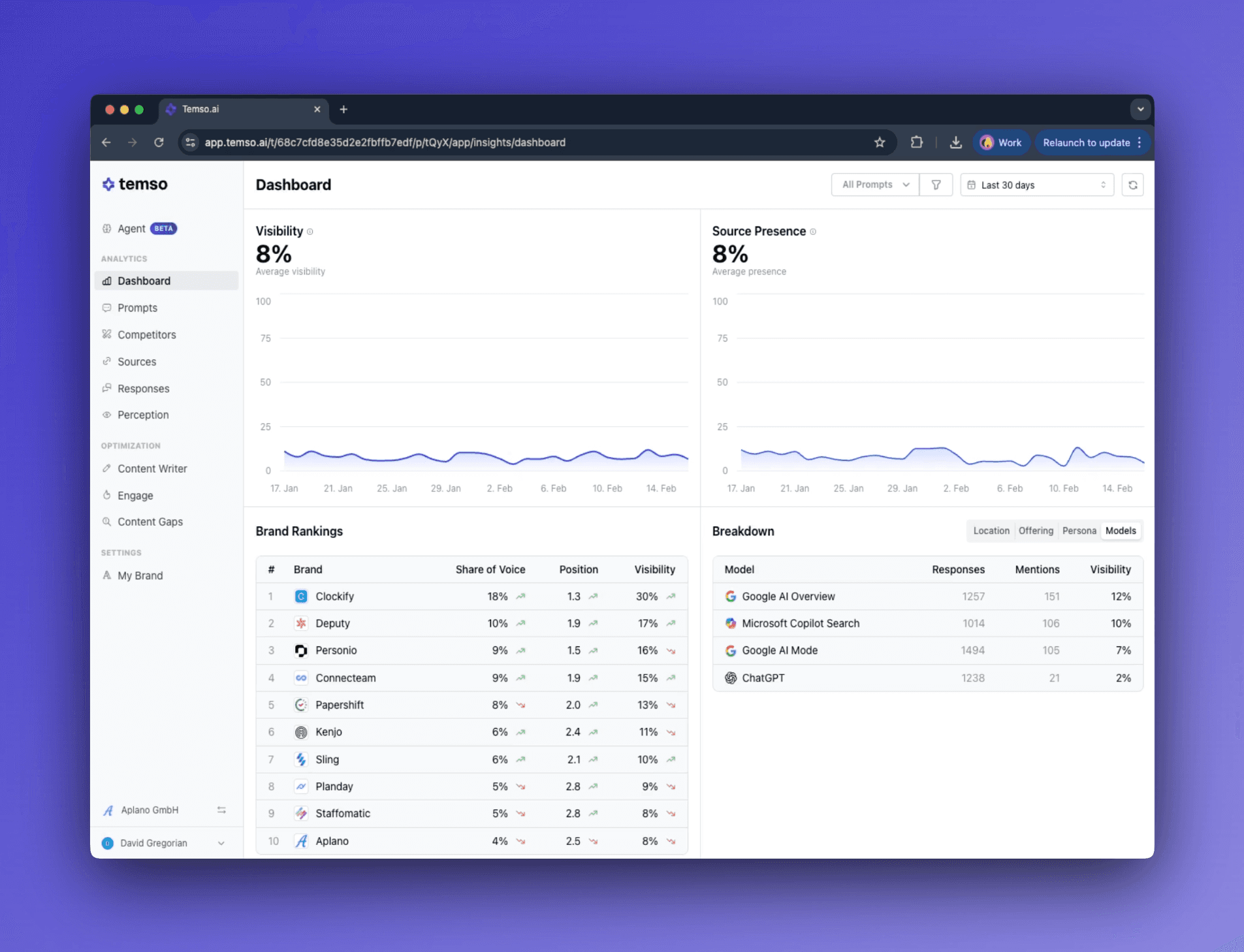
The key metric to watch is the trend. Going from zero mentions to occasional mentions is progress. Going from occasional mentions to consistent top-3 positioning is the goal.
Presence is the most fundamental indicator in AEO. If you’re not showing up at all, nothing else matters yet.
What Are the Best ChatGPT SEO Tools?
The AI search optimization space is evolving quickly. Here are the categories of tools that help:
AI search monitoring platforms
These track your brand’s visibility across LLMs. They answer the question: “Does ChatGPT mention us, and what does it say?”
Temso AI is built specifically for this, monitoring AI visibility across ChatGPT, Perplexity, Google AI Overviews, and other models. It tracks presence, position, perception, and sources across multiple markets and personas. See how Aplano improved their AI visibility using this approach.
For a comprehensive comparison, check our roundups of the top GEO tools and top AEO tools.
Content optimization tools
Standard SEO content tools (Clearscope, SurferSEO, Frase) help you create content that ranks in Google, which increases the chance of ChatGPT retrieval. They’re not AI-search-specific, but they’re a building block.
Brand monitoring tools
Tools like Mention, Brandwatch, or even Google Alerts help you track third-party mentions of your brand. These mentions feed into ChatGPT’s understanding of your brand over time.
Technical SEO tools
Schema markup validators, site speed analyzers, and crawlability checkers ensure your content is accessible to AI retrieval systems. Google Search Console is essential for tracking how Google (and by extension, Google AI Overviews) sees your site.
What Are the Most Common ChatGPT Optimization Mistakes?
- Thinking you can “game” ChatGPT: unlike Google’s algorithm, you can’t keyword-stuff your way into an AI answer. LLMs understand context and meaning. Manipulative tactics that might work in traditional SEO (doorway pages, link schemes, thin content at scale) don’t translate to AI search. Focus on being genuinely useful and authoritative.
- Ignoring third-party content: brands over-invest in their own website and under-invest in their presence across the broader web. In AI search, third-party mentions may matter more than your own pages. A single mention in a well-regarded comparison article can do more for your AI visibility than ten blog posts on your own site.
- Not monitoring AI outputs: most brands have no idea what ChatGPT says about them. They’re optimizing blind. Set up regular monitoring, even manual spot-checks, so you know your starting point and can track progress.
- Treating it as a one-time project: AI search visibility is not a “set and forget” exercise. Models get updated, retrieval systems change, competitors publish new content, and user prompts evolve. This requires ongoing attention, similar to traditional SEO.
- Waiting until it “matters more”: AI search is growing at a very fast pase and the brands that build AI visibility now will have a compounding advantage. Waiting means competing against entrenched incumbents later.
Getting Started
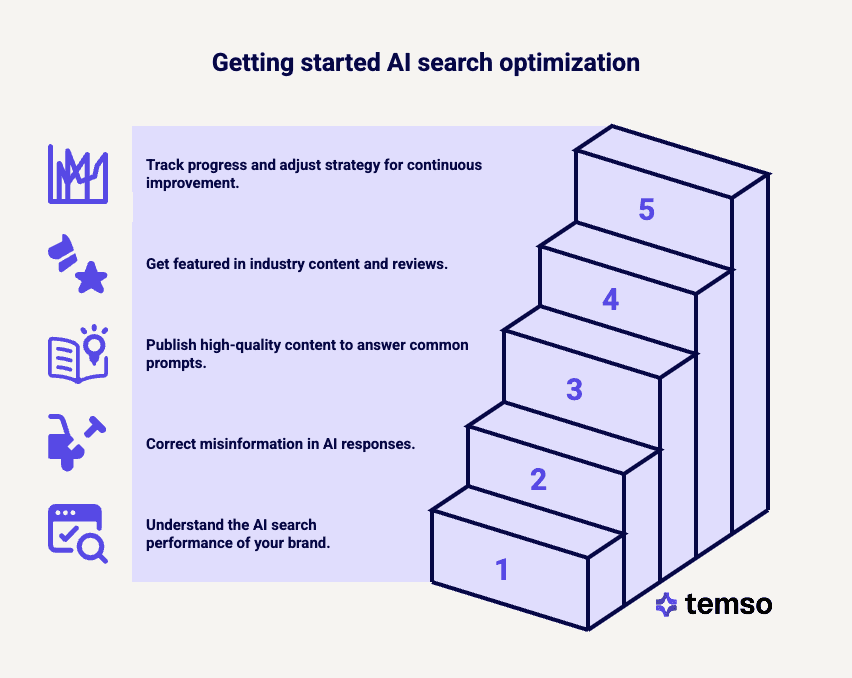
If you’re starting from zero, here’s the priority order:
- Audit. Understand what AI models currently say about your brand and category.
- Fix accuracy. Correct any misinformation in AI responses by updating your web presence.
- Create cornerstone content. Publish 3-5 high-quality pieces that directly answer your category’s most common AI prompts.
- Build third-party mentions. Get featured in roundups, reviews, and industry content.
- Monitor and iterate. Track your progress monthly and adjust your strategy.
The brands winning in AI search today aren’t doing anything magical. They’re being intentional about a channel that most competitors are still ignoring.
Frequently Asked Questions
Does optimizing for ChatGPT actually work?
Yes. ChatGPT’s responses are built from training data and real-time web retrieval, both of which you can influence. Brands that invest in consistent third-party mentions, structured content, and active monitoring see measurable improvements in AI visibility over time. It’s not instant (training data updates are slow), but retrieval-based improvements can show results within weeks.
How long does it take to show up in ChatGPT?
It depends on the mechanism. If ChatGPT retrieves your content through its search index, results can appear within days of publishing, once OAI-SearchBot has crawled the page. If you're trying to influence the model's base knowledge (training data), that takes longer, typically months, since models are retrained periodically and each has a fixed knowledge cutoff. The fastest path is publishing high-quality, crawlable content and making sure OAI-SearchBot is allowed.
Is ChatGPT SEO the same as GEO or AEO?
They’re closely related. ChatGPT SEO specifically focuses on optimizing for ChatGPT. Generative engine optimization (GEO) is the broader practice of optimizing for all AI-powered search engines, including Perplexity, Google AI Overviews, and others. Answer engine optimization (AEO) is often used interchangeably with GEO. The strategies overlap significantly. If you optimize well for ChatGPT, you’ll likely see benefits across other AI platforms too.
Can I optimize for ChatGPT without a big budget?
Absolutely. The most impactful actions (creating well-structured content, ensuring consistent brand messaging, and getting mentioned in relevant third-party content) don’t require paid tools. Manual monitoring (asking ChatGPT about your category monthly) costs nothing. Paid tools like Temso AI help you scale and automate, but you can start with manual effort and invest as you see results.
What’s the difference between ChatGPT SEO and traditional SEO?
Traditional SEO optimizes individual pages to rank in search results. ChatGPT SEO optimizes your brand’s presence across the entire web to influence AI-generated answers. In traditional SEO, you control the page that ranks. In ChatGPT SEO, you influence an answer that’s built from dozens of sources, many of which you don’t control. The core skills transfer (content quality, technical structure, authority building), but the strategy and measurement are different. See the full comparison table above.
How do I know if ChatGPT mentions my brand?
The simplest way: ask it. Run 10-15 category-relevant prompts in ChatGPT and record whether your brand appears. For systematic tracking, tools like Temso AI monitor your brand visibility across multiple AI models, prompts, and markets automatically. The key metrics to track are presence (do you show up?), source presence (is my content cited?), and perception (what does the AI say about you?).
Does my website need to be indexed by Google for ChatGPT to find it?
Partly. ChatGPT search runs on its own index, built by OAI-SearchBot, rather than on Google's rankings, so being allowed and crawlable matters more than your Google position. That said, the same fundamentals drive both, and sites that rank well in Google tend to be well-structured and widely referenced, which helps here too. For the model’s base training knowledge, not necessarily. Your brand could be mentioned in other indexed sources that the model learned from. But in practice, a well-indexed website is the foundation for both traditional and AI search visibility. This is why fixing technical SEO basics (sitemaps, crawlability, schema markup) matters even for ChatGPT optimization.