




Executive summary
Ask an AI model about the best recruitment agencies for executive search, and you get one set of sources. Ask the same model about the best agencies for tech hiring, and you get an almost entirely different set. We analyzed more than 200,000 AI citations and documented our findings in this study.
Across 12 countries, 87.6% of cited domains appear in only one country. Just 23 domains (including Clutch, Reddit, and LinkedIn) have high authority in all 12 countries of the study.
For HR and recruitment firms, this means AI visibility cannot be won with a single content strategy. The sources that earn citations for executive search (industry publications, established headhunting networks) are invisible to volume hiring prompts (where TikTok and Adecco dominate). B2B review directories like Clutch and GoodFirms are the rare exception (they are cited across all sub-verticals and all countries) making presence on these platforms the single most efficient investment for broad AI visibility.
Highlights
- The dataset: Over 200,000 AI source citations underpin this analysis, produced by prompts specific to the HR and recruitment industry. The AI responses from four AI models span 12 countries over the course of Q2 2026.
- TikTok is Google AI Overview's #1 source for volume hiring: Google AI Overview cites TikTok more than any other domain for mass recruitment prompts.
- 23 domains appear across all 12 countries: This means that under 1% of all domains in the study proved to be truly global, led by Clutch, Reddit, and LinkedIn.
- 4x localization gap between models: Microsoft Copilot shares just 2% of sources across country pairs, while Grok shares 10%.
- 63% of domains are sub-vertical exclusive: Nearly two-thirds of all sources cited by AI models for HR prompts appear in only one hiring category (executive search, tech, volume, startups, or general).
- 88% of domains are country-exclusive: Almost nine out of ten cited sources appear in only one of the 12 countries studied, even when the underlying recruitment prompt is identical.
Ask about executive search, get executive search sources. Ask about startups, get startup sources.
Do AI models cite different sources for different types of recruitment?
Yes, with a wide difference between sub-verticals. Out of all citations analyzed, 63% of domains appear in only one sub-vertical. Each hiring niche has built its own content ecosystem, with specialized domains that never surface for other hiring needs.
| Sub-Vertical | Exclusive domains | Type of domains that drive AI visibility |
|---|---|---|
| Startups | 40.4% | VC-backed platforms, accelerators, founder communities |
| Volume Hiring | 39.2% | RPO firms, outsourcing platforms, mass staffing operations |
| Executive Search | 39.6% | Headhunting networks, C-suite publications, leadership media |
| Tech Hiring | 35.0% | Developer communities, tech recruitment specialists |
| General | 28.2% | Broad HR directories, industry associations |
.png&w=3840&q=99&dpl=dpl_CGCrv29s8to86yNfpcjqYKh8nsz3)
What are the top cited domains in each HR & Recruitment sub-vertical?
The top-cited domains tell the story most clearly. Each sub-vertical has a different #1, #2, and #3 source:
| Rank | General | Tech Hiring | Executive Search | Startups | Volume Hiring |
|---|---|---|---|---|---|
| 1 | clutch.co | reddit.com | clutch.co | reddit.com | clutch.co |
| 2 | themanifest.com | clutch.co | stantonchase.com | clutch.co | reddit.com |
| 3 | goodfirms.co | devsdata.com | linkedin.com | f6s.com | asanify.com |
| 4 | linkedin.com | herohunt.ai | ensun.io | devsdata.com | linkedin.com |
| 5 | reddit.com | linkedin.com | forbes.com | goodfirms.co | adecco.com |
Every model picks a different winner
What is the most cited source for HR recruitment in each AI model?
The divergence goes deeper than sub-vertical. Each AI model also has its own preferred source for each hiring category, and they almost never agree.
| Sub-Vertical | Google AI Overview | Microsoft Copilot | ChatGPT | Grok |
|---|---|---|---|---|
| General | instagram.com | themanifest.com | clutch.co | clutch.co |
| Tech Hiring | devsdata.com | peoplemanagingpeople.com | devsdata.com | reddit.com |
| Executive Search | levuexecutives.com | t-mapp.com | clutch.co | clutch.co |
| Startups | devsdata.com | themanifest.com | clutch.co | reddit.com |
| Volume Hiring | tiktok.com | clutch.co | asanify.com | clutch.co |
Google AI Overview is the outlier. Its #1 source for volume hiring is TikTok. Its #1 source for general HR is Instagram. Google AI Overview is surfacing social media platforms as primary recruitment sources which is a fundamentally different strategy than the other models, which favor B2B directories and industry publications.
ChatGPT gravitates toward B2B directories, with Clutch dominating three of five categories. Grok splits between Clutch and Reddit, reflecting its broader, more community-driven source base. Microsoft Copilot is the most varied, citing a different top domain in four of five categories.
The practical implication: every niche and model needs to be optimized for independently. A firm that only optimizes for Clutch (ChatGPT's favorite) will be invisible to Google's AI Overview, which is looking at entirely different platforms.
Executive search is the hardest sub-vertical to crack
How concentrated are AI source citations for different types of recruitment?
Beyond which domains rank highest, there is a structural difference in how concentrated or fragmented each sub-vertical's source ecosystem is.
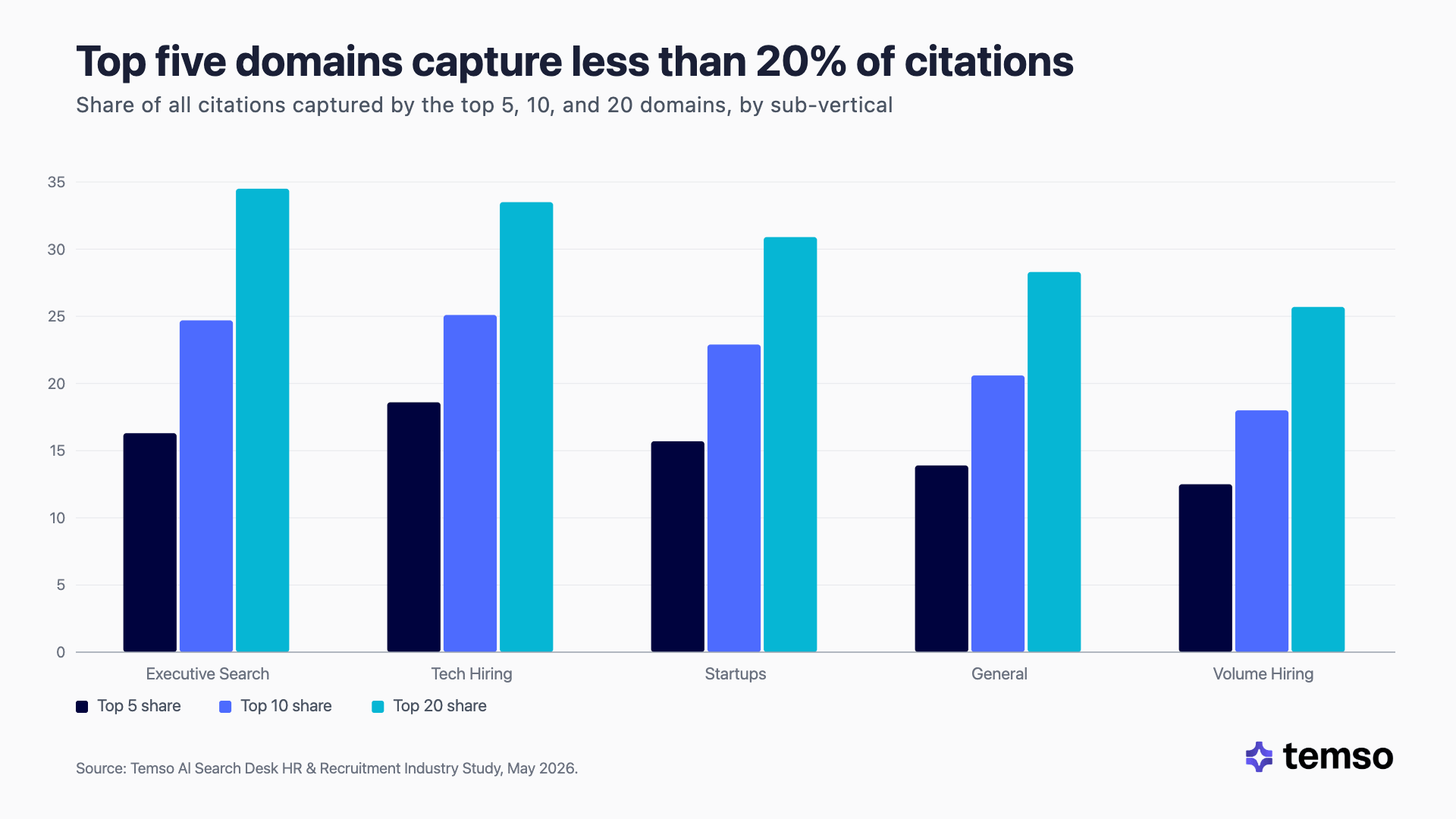
Executive search has the highest top-20 concentration (34.5%) with the fewest unique domains. Twenty sources capture more than a third of all citations. The market is controlled by a small club of established headhunting firms and publications. Breaking into AI visibility for executive search means displacing deeply entrenched institutional sources.
Volume hiring is the opposite: the lowest concentration (25.7% top-20 share) and one of the broadest domain pools. No single source dominates. The long tail of local staffing agencies, regional outsourcing firms, and emerging HR tech platforms is wide and constantly shifting. This fragmentation means more opportunity.
Startups has the broadest domain pool overall, reflecting the startup ecosystem's sprawling, constantly-evolving web of directories, accelerator sites, VC-backed platforms, and founder blogs.
88% of domains only appear in a specific country
Do AI models cite different recruitment sources in different countries?
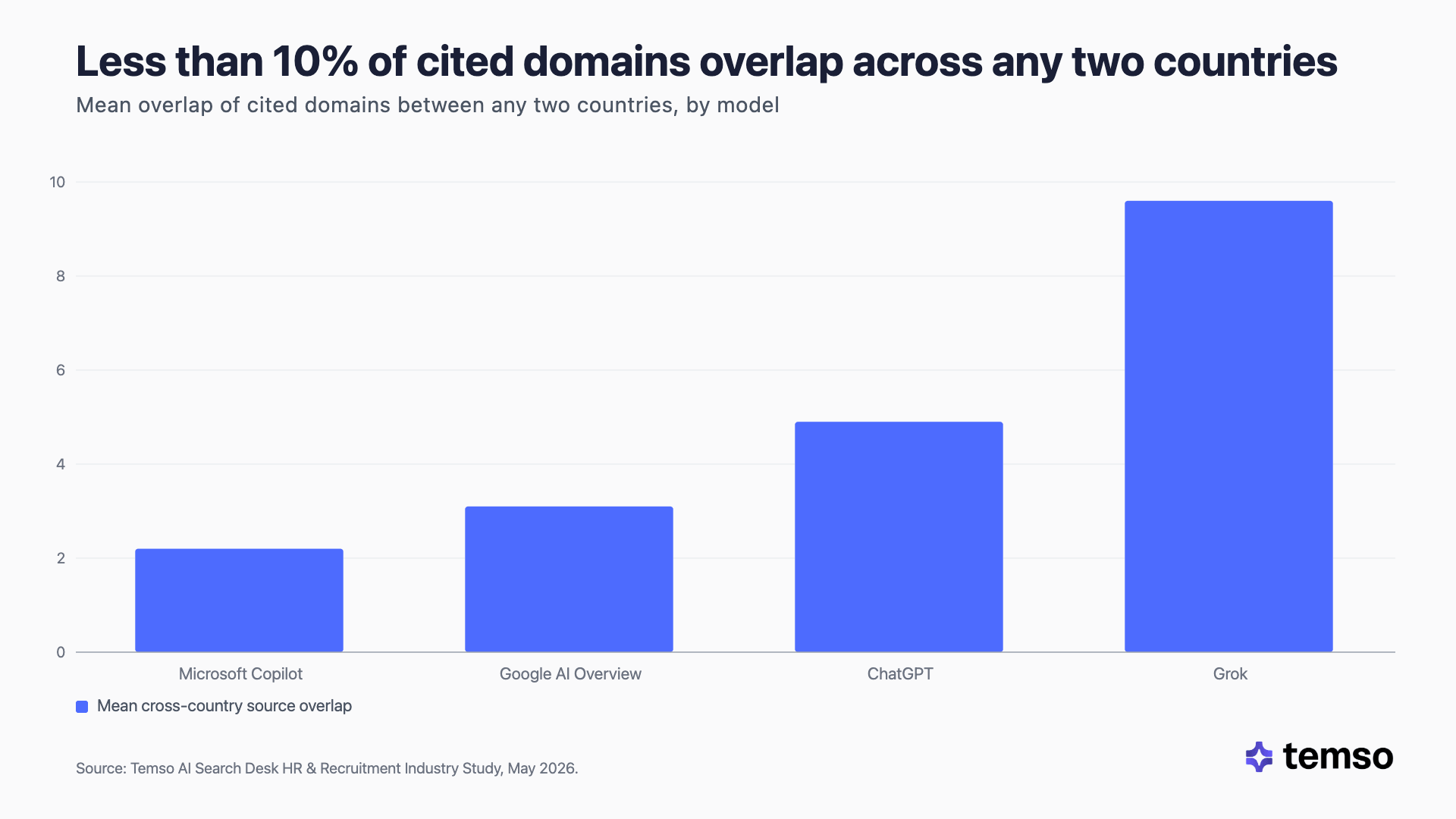
The geographic dimension compounds the sub-vertical fragmentation. When the same recruitment prompt is asked in two different countries, AI models cite almost entirely different sources.
Source overlap between any two countries (measured as the percentage of shared domains) ranges from 2.2% to 9.6% depending on the model:
Traditional staffing giants with global brand recognition (Adecco and Robert Half) are far less prominent than B2B directories. Clutch alone receives more than five times as many citations as Adecco.
Language helps, but not much.
Do same-language countries share more AI recruitment sources?
Countries sharing a language do share more sources. English-speaking pairs (US, Canada, Australia, UK) and Spanish-speaking pairs (Mexico, Argentina, Spain) show 1.5–2.6x higher overlap than cross-language pairs. But even same-language overlap remains remarkably low.
| Model | Same-Language Overlap | Cross-Language Overlap |
|---|---|---|
| Microsoft Copilot | 3.5% | 2.0% |
| Google AI Overview | 8.0% | 2.1% |
| ChatGPT | 8.1% | 4.4% |
| Grok | 13.1% | 9.0% |
The Canada–US pair shows the highest overlap across all models (12.2% for ChatGPT, 15.3% for Grok), reflecting the deeply integrated North American recruitment market. Australia, despite sharing a language with the US and UK, is notably more isolated (5.0–9.2% overlap with other English-speaking countries), reflecting its geographic distance, distinct visa frameworks, and self-contained staffing industry.
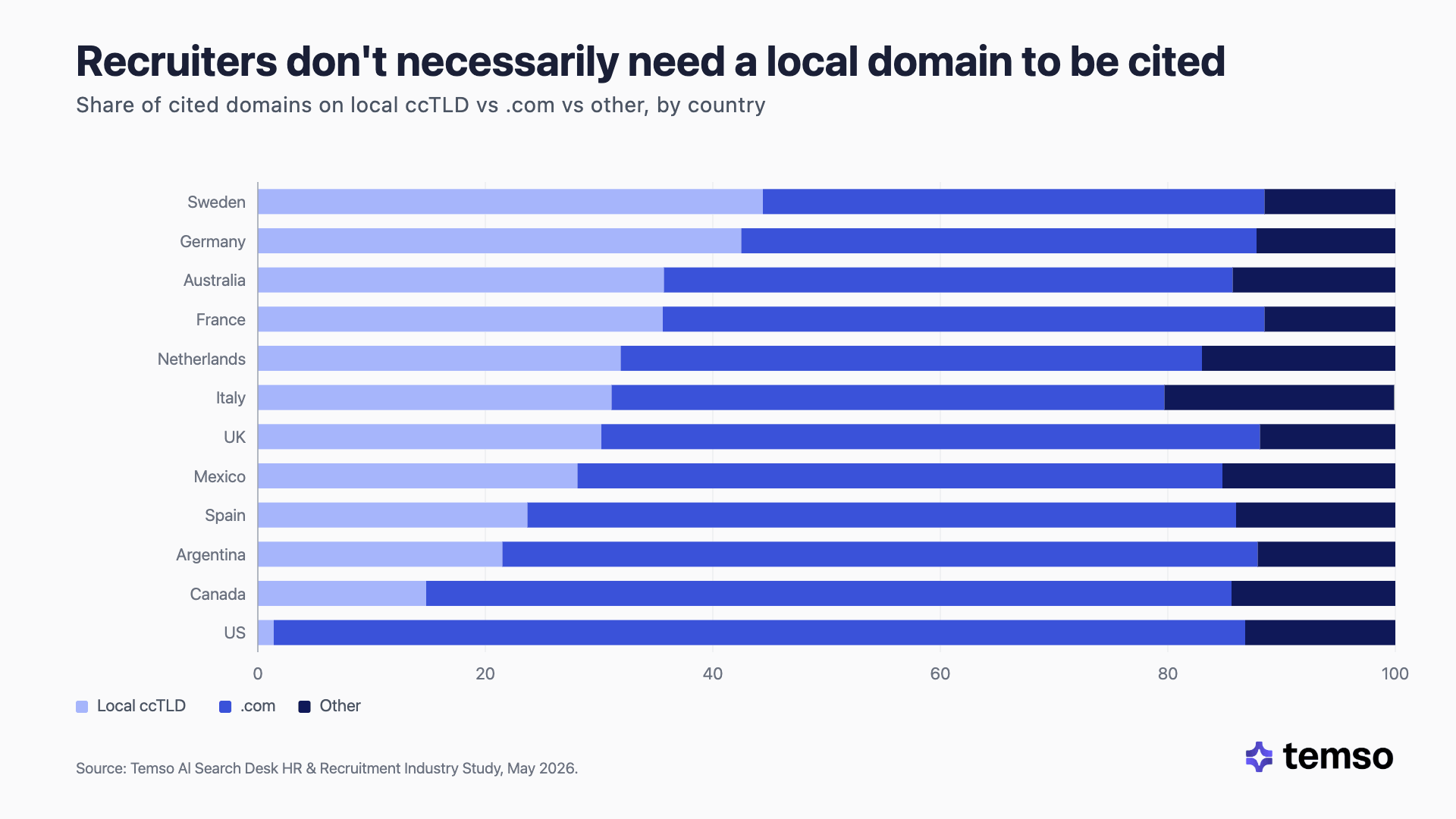
The depth of local content ecosystems is visible in how countries split between local domain extensions and .com:
| Country | Local TLD % | .com % | Other % |
|---|---|---|---|
| Sweden | 44.4% | 44.1% | 11.5% |
| Germany | 42.5% | 45.3% | 12.2% |
| Australia | 35.7% | 50.0% | 14.3% |
| France | 35.6% | 52.9% | 11.5% |
| Netherlands | 31.9% | 51.1% | 17.0% |
| Italy | 31.1% | 48.6% | 20.2% |
| UK | 30.2% | 57.9% | 11.9% |
| Mexico | 28.1% | 56.7% | 15.2% |
| Spain | 23.7% | 62.3% | 14.0% |
| Argentina | 21.5% | 66.4% | 12.1% |
| Canada | 14.8% | 70.8% | 14.4% |
| US | 1.4% | 85.4% | 13.2% |
Context
This analysis draws from a dataset of over 200,000 source citations generated from four major AI platforms (ChatGPT, Microsoft Copilot, Grok, and Google AI Overview). These were prompted with HR and recruitment questions across 12 countries and 7 languages.
The prompts covered five types of recruitment needs: general HR agency recommendations, tech hiring, executive search, high-volume hiring, and startup staffing. Each prompt was translated and localized for its target market (e.g., "Best HR and recruitment agencies in the US for tech hiring" became "Beste HR und Personalvermittlungsagenturen in Deutschland für Tech Recruiting" in Germany). This design creates a natural experiment: the intent is constant, but the country, language, and sub-vertical vary.
The findings are most directly relevant to HR and recruitment firms, B2B marketing teams in the staffing industry, and anyone building content strategies to improve visibility in AI-generated recommendations. The data represents a single monitoring period and a specific set of prompts.
Methodology
How we measured this
We measured source divergence along two dimensions: across HR sub-verticals (do AI models cite different sources for executive search vs. tech hiring?) and across countries (do they cite different sources in the US vs. Germany?).
For geographic divergence, we computed the domain overlap rate between every pair of countries for each AI model. This rate represents the percentage of domains shared between two countries. For example, if Country A cites 200 unique domains and Country B cites 300, and they share 25 domains in common, the overlap rate is 25 / 475 = 5.3%. Lower numbers mean more divergence.
For sub-vertical divergence, we measured domain exclusivity which is the percentage of domains that appear in only one of the five hiring categories. We also tracked source concentration by calculating what share of total citations the top 5, 10, and 20 domains capture in each category.
All language comparisons were validated for statistical significance. The geographic analysis covers 66 country pairs per model, well above the minimum threshold for reliable estimates. The same-language subgroup (9 pairs) is below the minimum threshold and those results are reported as directional rather than conclusive.
Frequently asked questions
Do AI models cite different sources for different types of recruitment?
Yes, and very dramatically. 63.3% of all domains cited by AI models for HR and recruitment prompts appear in only one sub-vertical. Executive search prompts surface headhunting firms and industry publications, while startup hiring prompts pull from the venture capital ecosystem. Just 5.8% of domains span all five hiring categories.
What is the most cited source for HR and recruitment in AI models?
Clutch.co leads across all 12 countries and all sub-verticals, followed by Reddit and LinkedIn. However, the #1 source changes depending on the sub-vertical and the model: Reddit leads for tech hiring and startups, while Clutch leads for general, executive search, and volume hiring.
Does TikTok appear in AI recruitment recommendations?
Yes. Google AI Overview cites TikTok as its #1 source for volume hiring prompts — more than any other domain in that category. This reflects TikTok's emergence as a genuine recruitment channel for high-volume roles in retail, hospitality, and logistics. Other models have not yet elevated TikTok to the same degree.
Do AI models recommend different recruitment agencies by country?
Almost entirely different ones. Between 90% and 98% of cited domains are unique to a single country, depending on the model. Microsoft Copilot is the most localized (just 2.2% overlap between country pairs), while Grok is the most global (9.6% overlap).
Which AI model is most localized for recruitment prompts?
Microsoft Copilot is the most localized, sharing just 2.2% of domains between any two countries on average. Google AI Overview is close behind at 3.1%. Both draw from geo-localized search indexes. ChatGPT (4.9%) and Grok (9.6%) are more global but still overwhelmingly local.
Are global staffing firms well-represented in AI citations?
Less than expected. Despite global brand recognition, Adecco receives five times fewer citations than Clutch. B2B review directories dominate the global citation landscape far more than traditional staffing brands. See the current HR & recruitment AI rankings for live visibility scores.
What does this mean for recruitment firms building AI visibility?
Recruitment firms need distinct strategies per service line and per country. Content that earns visibility for executive search has near-zero transfer to tech hiring or startup recruitment. B2B review directories (Clutch, GoodFirms, The Manifest) are the rare platforms that cross both sub-vertical and geographic boundaries, making directory presence a very efficient single investment.
How was this study measured?
Source overlap was measured using the Jaccard similarity coefficient (the ratio of shared domains to total unique domains between any two groups). Sub-vertical exclusivity was measured as the percentage of domains appearing in exactly one of five hiring categories. The analysis covers over 200,000 source citations, 12 countries, 7 languages, and 4 AI models.