



TL;DR The best AI visibility tools track your brand across ChatGPT, Perplexity, Gemini, Claude, and Google AI Overviews, then tell you what to do about the gaps. The category splits into two camps: dashboards that hand you a chart, and agents that hand you a deliverable. Temso AI leads the agent camp, monitoring visibility, perception, citations, and accuracy across every major model, then shipping the briefs, action plans, and outreach targets to close the gaps. Profound is the enterprise pick. AthenaHQ leads on Shopify and GA4 revenue attribution. Evertune is the CMO pick when you need million-prompt statistical confidence. Gumshoe AI is the only tool with true pay-as-you-go pricing at $0.10 per conversation. Gauge is the YC-backed agent for teams that want articles written automatically. LLMrefs is the keyword-first pick for SEOs. Pick the one that matches your bottleneck, not the longest feature list.
Why AI visibility matters now
Three numbers explain the shift.
- 69% of Google searches ended without a click in 2025, up from 56% in 2024. (Similarweb via CXL)
- 2.5 billion ChatGPT prompts a day as of mid-2025. (OpenAI via TechCrunch)
- 25% projected drop in traditional search engine volume by 2026 as users move to AI chatbots. (Gartner, 2024)
- 71% of domains cited by AI appear in only one model's responses, based on our analysis of 2M+ citations across ChatGPT, Google AI Overview, Gemini, Grok, and Copilot. (Temso AI Search Data Study)
When a buyer asks "best [your category]," the AI returns three to five named brands and a few cited sources. Everyone outside that list is invisible. Your Google rank does not predict your AI citation: independent research finds only around 12% of ChatGPT citations match the URLs on Google page one. AI visibility is a separate measurement layer with its own KPIs, its own playbook, and its own tooling.
What is an AI visibility tool?
An AI visibility tool measures how often, how accurately, and in what context your brand appears inside answers generated by ChatGPT, Perplexity, Gemini, Claude, Microsoft Copilot, and Google AI Overviews. The good ones also tell you which sources got cited in your place, how sentiment is moving, and what to publish next. The very best ones do that work for you. For a deeper read on how to parse an AI response in the first place, see our guide to the anatomy of an AI response.
Five core metrics matter. They map onto the Four P's framework we use across our research:
- Mention rate. Percentage of tracked prompts where your brand appears. See presence.
- Share of voice. How often you appear versus competitors on the same prompts.
- Citation rate. Which URLs the AI links to when it mentions you.
- Placement. Whether you appear first, in a list, or only as an aside.
- Sentiment. Whether the AI describes you positively, neutrally, or negatively.
Most platforms report these well enough. The split point is what happens next.
The category split: dashboards vs agents
Dashboards report. Agents act.
A dashboard tool tells you that competitor X has a higher share of voice on twelve high-intent prompts. Your team has to interpret the data, prioritise the gaps, write the briefs, find the placements, and ship the content. That works if you have a dedicated AEO analyst. Most teams do not.
An agent tool runs the same monitoring, then prioritises the gaps, drafts the briefs, suggests outreach targets, and queues the work for your approval. You stay in the loop. The agent does the legwork.
This is the most important question you can ask a vendor: "show me the next action you would have me take, and the artifact you would produce to do it." If the answer is a CSV export, the tool is a dashboard.
Best AI Visibility Tools in 2026 at a glance
| # | Tool | Best for | Engines tracked | Action layer | Starting price |
|---|---|---|---|---|---|
| 1 | Temso AI | Agent-driven AI visibility, plus an $89/mo Starter plan | 8+ | Agent ships briefs and executes | $89/mo (Starter) |
| 2 | Profound | Enterprise teams that need broad coverage and exec-grade reporting | 9 | Agent snippets, no full briefs | $99/mo (limited) |
| 3 | AthenaHQ | Shopify ecommerce with GA4 revenue attribution | 6+ | Autonomous draft workflows | $295/mo |
| 4 | Evertune | CMO-grade reporting at million-prompt statistical scale | 10+ | Reporting only | Custom quote |
| 5 | Gumshoe AI | Teams that want true pay-as-you-go pricing with persona-driven analysis | 11 | Content generator targeting persona gaps | $0.10/conversation |
| 6 | Gauge | YC-backed agent built around a content engine that publishes 3 to 18 articles per month | 7 | Agent + content engine ships articles | $100/mo |
| 7 | LLMrefs | SEOs who want a keyword-first AI tracker with full engine coverage at a flat price | 11 | Auto-generated fan-out prompts | $79/mo (free tier) |
| 8 | Peec AI | Agencies running AI visibility for multiple clients | 6+ | Owned/Earned task split | €85/mo |
| 9 | Scrunch | Sites that want to control how content is served to AI bots | 4 (Core), 9 (Enterprise) | AXP delivery layer | $250/mo |
| 10 | Neuroflash | DACH brands needing German tuning and EU data residency | 4+ | Content generation suite | Free, paid from €30/mo |
| 11 | Ahrefs Brand Radar | SEO-first agencies already on Ahrefs | 6 | Monitoring only | $129/mo (Lite) |
| 12 | Semrush AI Visibility Toolkit | Teams already using Semrush for traditional SEO | 5 | Limited recommendations | $99/mo on top of Semrush |
How we evaluated these tools
Five criteria, weighted by what actually moves the needle for a marketing team running an AI visibility programme.
| Criterion | Weight | What we looked at |
|---|---|---|
| Analytics coverage | 25% | Number of engines, surfaces (chat, AI Overviews, citations), and locale depth |
| Recommendation quality | 20% | Whether the tool turns a share-of-voice gap into specific direction |
| Action execution | 15% | Whether the tool produces the deliverable that closes the gap |
| Usability | 20% | Whether a non-analyst can read the dashboard in under two minutes |
| Pricing accessibility | 20% | Whether the entry tier returns useful insight without a sales call |
Tools that gate basic share-of-voice numbers behind enterprise pricing scored lower regardless of feature parity. Tools that stop at the dashboard scored lower than tools that ship the brief.
What our citation data says about the criteria
Three findings from Temso's own research shaped how we weighted analytics coverage, locale depth, and engine breadth.
1. Single-engine tracking misses most of the picture. Across 2 million AI citations we analyzed, 71% of cited domains appear in only one model's responses, and at the page level 89% of URLs are exclusive to one model. Even the two most-overlapping engines (Google AI Overview and Grok) share just 20.6% of cited domains. The average pair of models shares only 14.4%. (Same question, different sources)
2. Language coverage matters as much as engine coverage. Our analysis of 7 million citations across six non-English languages found a 34-point gap between Google AI Overview (85% local-language citation) and Grok (52%). On Dutch prompts, Grok cites more English sources than Dutch ones. If you operate outside English-speaking markets, locale depth is non-negotiable. (Lost in translation)
3. SaaS authority does not cross borders. We tracked over 1 million citations for global software categories across 12 countries and found 81 to 93% of cited domains never appear outside a single market. Even Canada and the US, the highest-overlap pair, only share 23.9% of sources. (Your SaaS authority ends at the border)
You can see the same fragmentation play out live in our public industry rankings, which track AI visibility leaders by category and country. The takeaway for tool selection: engine breadth is table stakes, but locale depth is the second axis buyers most often underweight.
1. Temso AI: Best overall
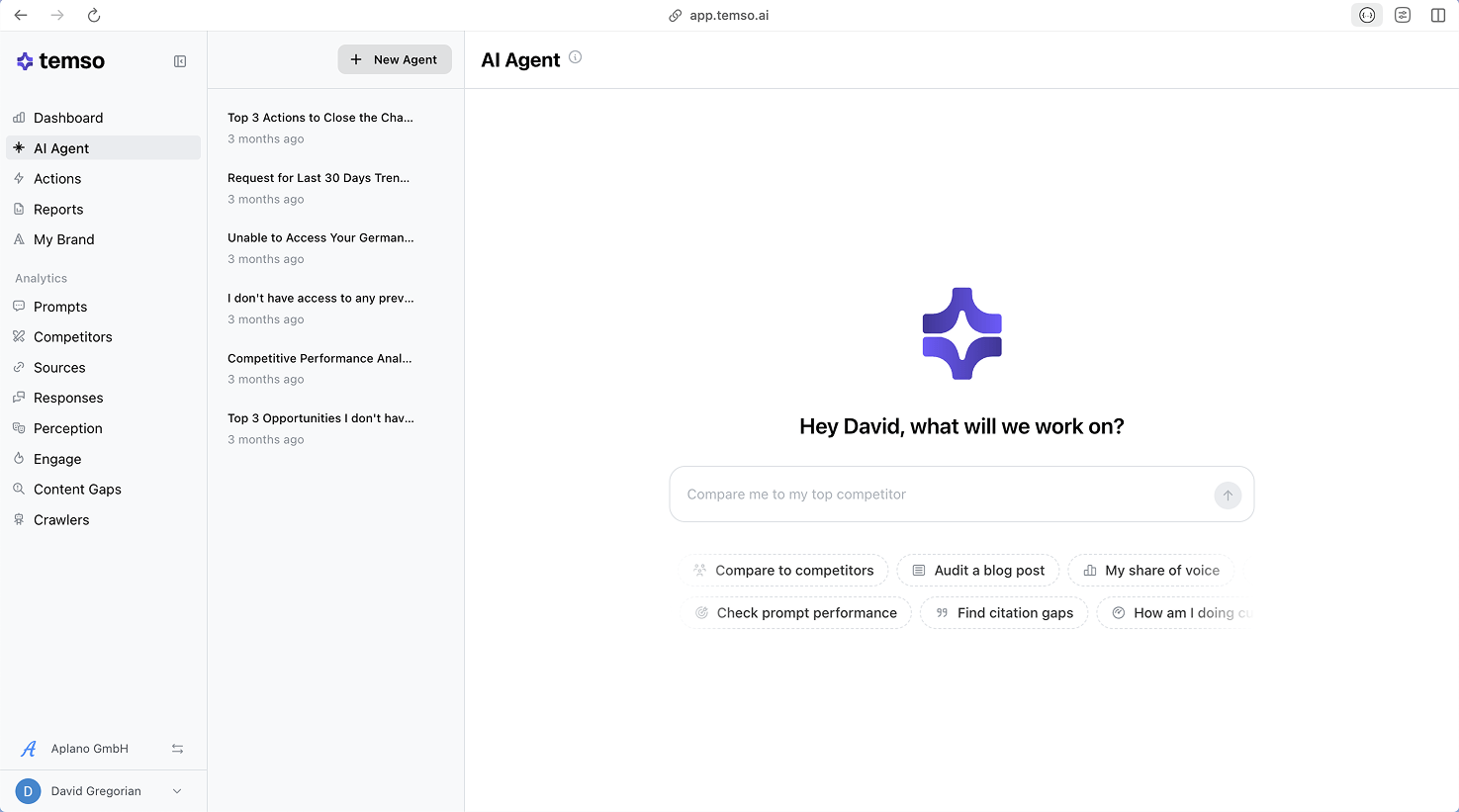
Score: 4.8/5
Temso is the only tool on this list built around an AI agent rather than a dashboard. It shows you the gaps, prioritises them, drafts the briefs, suggests the outreach targets, then executes inside the guardrails you set. The agent works against four outcomes: citations, visibility, perception, and accuracy. Coverage spans ChatGPT, Perplexity, Gemini, Claude, Google AI Overviews, AI Mode, Copilot, and Grok.
Best for: Mid-market teams that need both measurement and execution in one tool.
Pros
- Agent-driven execution, not just monitoring
- $89/mo Starter plan for teams starting out
- Continuous tracking on a stable prompt set
- Real-time AI crawler logs show which LLMs are hitting which pages, which is the closest thing to true attribution in the category
- 4.8 on G2
Cons
- Smaller integration ecosystem than legacy SEO suites
- No traditional SEO features like backlink indexing
Pricing. Starter plan from $89/mo. Agent-driven plans with brief generation and execution on the higher tiers. Free trial.
2. Profound: Best for enterprise
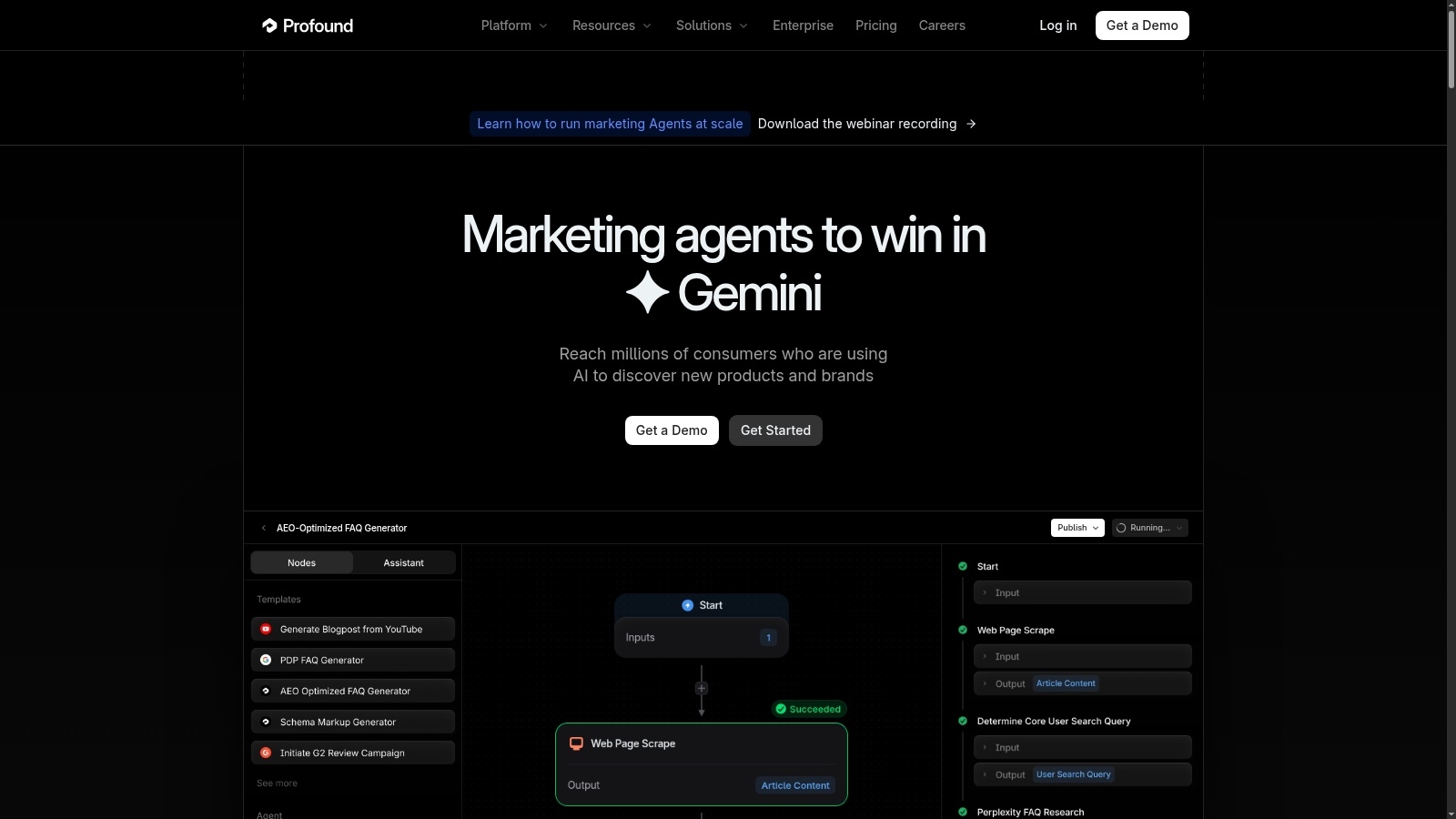
Score: 4.2/5
Profound covers nine answer engines including Meta AI and DeepSeek. The reporting language is built around share of voice in the way exec teams already understand. SOC 2 and SSO clear procurement. Prompt Volumes and Conversation Explorer surface what real users actually ask. Backed by $58.5M raised, including a Series B led by Sequoia.
Best for: Enterprise marketing teams reporting AI visibility upward.
Pros
- Nine-engine coverage including Meta AI and DeepSeek
- Exec-grade reporting and CDN attribution (Cloudflare, Vercel)
- SOC 2 and SSO for enterprise procurement
Cons
- Starter at $99/mo limited to ChatGPT and 50 prompts
- Full value sits on the $399/mo Growth tier or Enterprise
- US-centric tuning; thinner depth on DACH and Spanish prompts
Pricing. Starter $99/mo (limited). Growth $399/mo. Enterprise custom.
3. AthenaHQ: Best for ecommerce revenue attribution
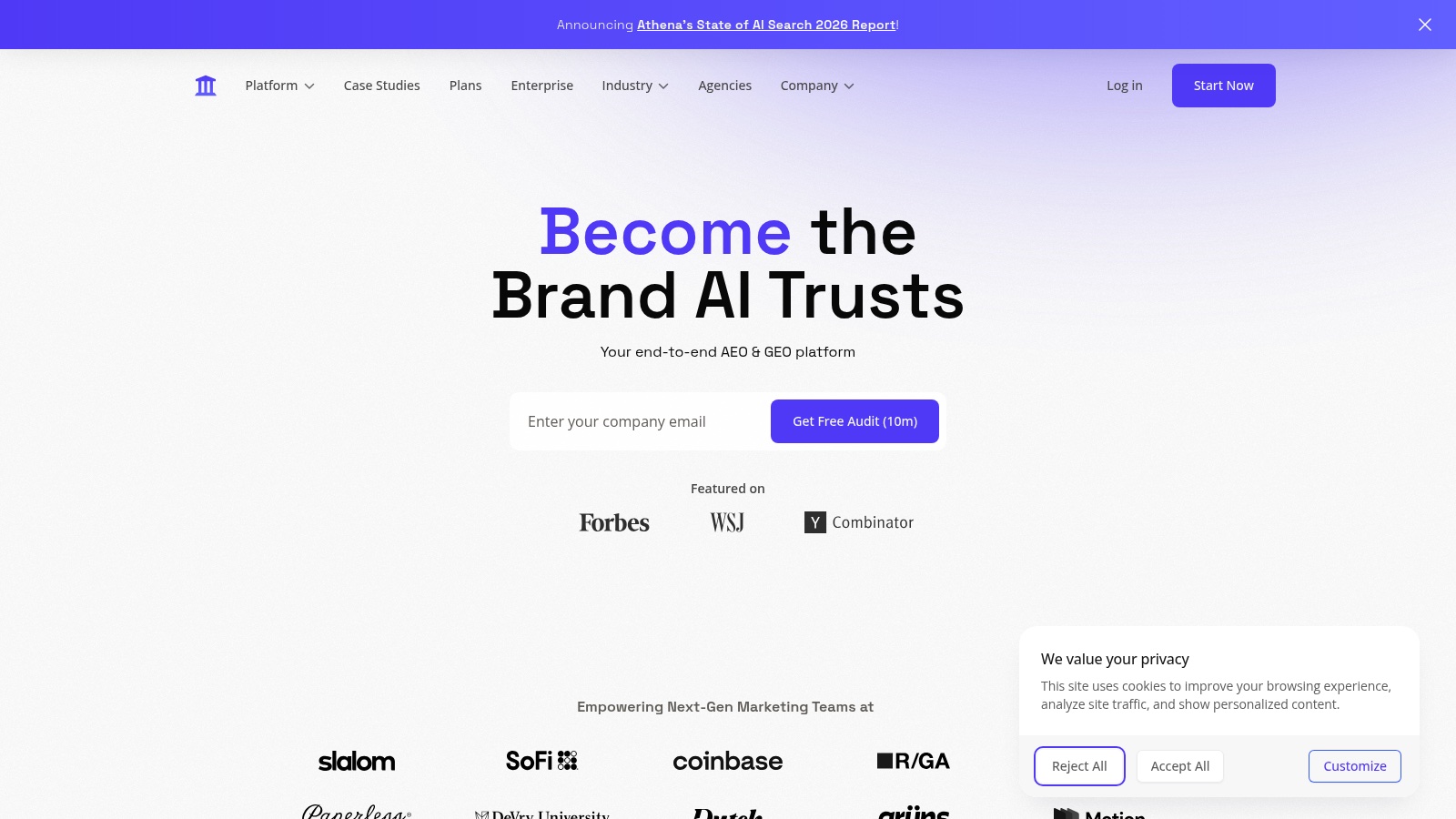
Score: 4.3/5
AthenaHQ is the only tool on this list that natively wires AI citation data into Shopify and GA4. The same dashboard that flags a missing mention shows the orders that came in after a fix. Autonomous workflows draft optimisations against the gaps the platform detects. For a Shopify-first brand, the trade-off favours attribution depth over engine breadth.
Best for: Shopify ecommerce brands that need GA4 revenue attribution.
Pros
- Native revenue attribution via Shopify and GA4
- Autonomous workflows draft optimisations from detected gaps
- Real-time alerts on competitor displacement
Cons
- Attribution value concentrated on Shopify
- Self-Serve plan limited to a single country; multi-region tracking requires Enterprise
- No free trial
Pricing. Self-Serve from $295/mo, with a $95 introductory rate for the first month (3,600 credits). Enterprise custom.
4. Evertune: Best for million-prompt statistical scale
Score: 4.4/5
Evertune runs roughly 1.25 million prompts per brand each month: 125 unique prompts, 100 runs each, across ten or more engines. Sample-based tools give you directional data. Evertune gives you a number you can defend in front of a CMO. The founding team came out of The Trade Desk via the AdBrain acquisition. Backed by $20M+ in funding, including a $15M Series A from Felicis (August 2025) with Eniac and NextView participating.
Best for: CMOs who need statistical confidence in the visibility number.
Pros
- 1.25M prompts per brand monthly delivers statistical significance
- Brand perception, sentiment, and favorability in one view
- Coverage spans 10+ engines including Meta AI and DeepSeek
Cons
- Custom-quote pricing; no self-serve pilot
- Reporting is the deliverable, not the brief
Pricing. Custom. Expect mid-five-figure annual contracts.
5. Gumshoe AI: Best for pay-as-you-go flexibility
Score: 4.0/5
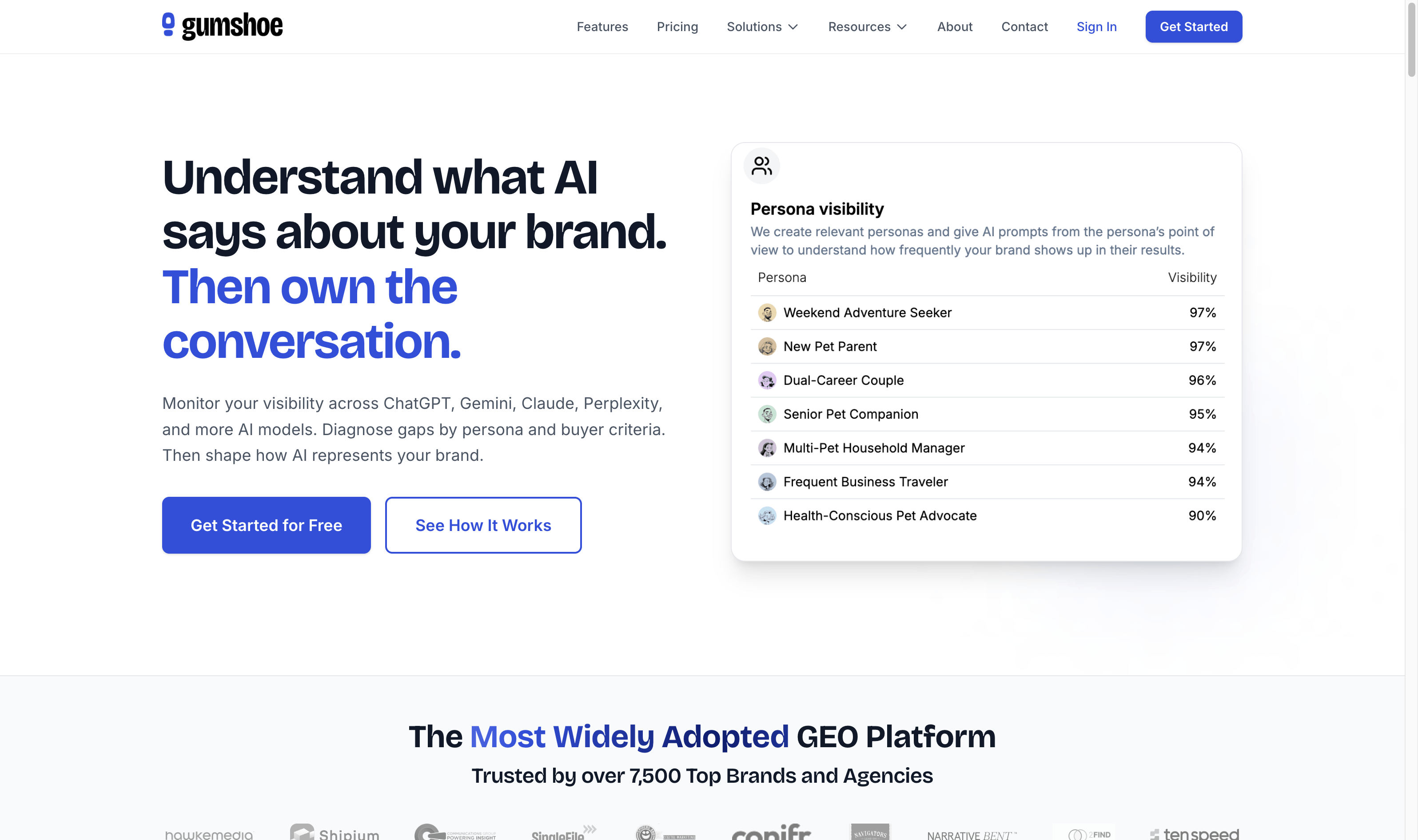
Gumshoe is the only tool in the category with true pay-as-you-go pricing: $0.10 per conversation, no monthly minimum, no annual contract. Stop using it for a month and you pay nothing. That alone makes it the cleanest fit for agencies running periodic audits, project-based work, or seasonal brands that do not need always-on tracking.
The methodology is the second differentiator. Most tools scrape AI outputs from anonymous sessions. Gumshoe runs every conversation as a specific buyer persona, complete with role, goals, and decision-making context, then reports how each persona sees your brand differently. Coverage spans 11 models including ChatGPT, Claude, Gemini, Perplexity, DeepSeek, and Grok. Founded in 2025 at Pioneer Square Labs in Seattle by Todd Sawicki (CEO, former CEO of Zemanta) and Patrick O'Donnell (co-founder of Urbanspoon). Raised a $2M pre-seed round in 2025. Customers include Hawke Media, Shipium, Sourcegraph, and Linkflow. Shipium reports a 557% increase in cited content from its domain in under four months.
Best for: Agencies and project-based teams that want flexible pricing tied to actual usage. Brand and persona marketing teams that need persona-segmented visibility data.
Pros
- True pay-as-you-go at $0.10/conversation; no monthly minimum
- Persona-driven analysis (AI-inferred buyer personas) that no other tool matches
- 11 AI models on every plan
- Page-level AIO score with JSON-LD and schema recommendations
- First report run is free
Cons
- Pay-per-conversation can scale unpredictably for high-volume monitoring
- No agent layer; content generator helps but does not autonomously execute
- Smaller integration ecosystem than the venture-backed players
Pricing. Free first report. Pay-as-You-Go at $0.10/conversation. Enterprise custom with volume discounts.
6. Gauge: Best for agentic content production at volume
Score: 4.0/5
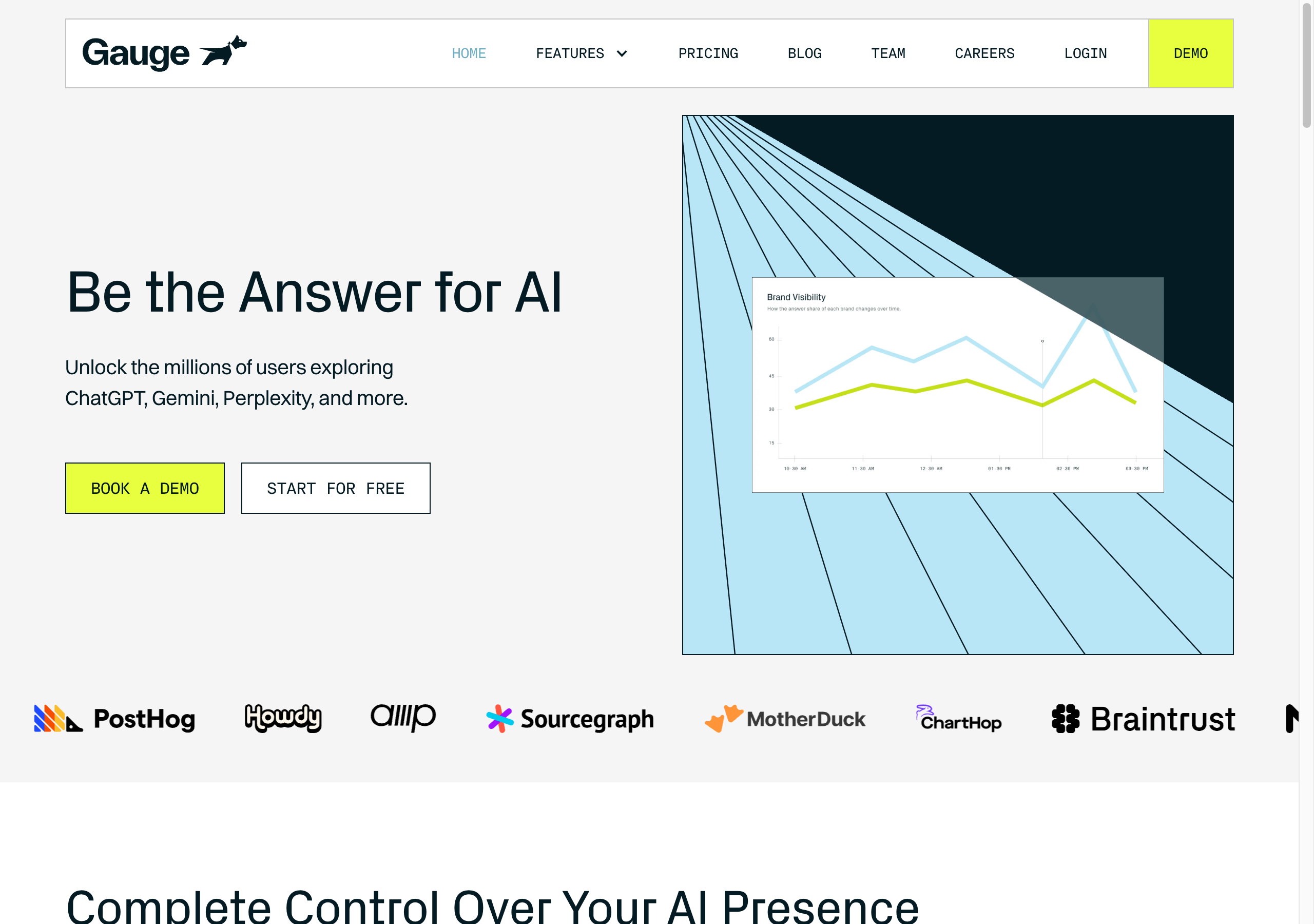
Gauge is the YC Summer 2024 entrant built around a single idea: the agent does the analysis, and a content engine writes the articles to close the gap. The Growth tier ships 18 articles per month from the engine, which is unique in the category. Coverage spans seven engines, with prompts run daily through live model UIs rather than APIs. Founded by Caelean Barnes (CEO) and Evan Doyle (CTO, ex-Carta), based in San Francisco. Backed by Y Combinator with a $500K investment in September 2024. Vellum AI moved from 1.4% to 40.3% AI visibility in seven months on Gauge; LedgerUp from 1% to 17% in under four weeks.
Best for: Mid-market teams that want an agent and an automated content pipeline in one product.
Pros
- Content engine ships 3 to 18 articles per month
- Prompts run daily through live model UIs, not API calls
- GA4, GSC, Slack, and S3 integrations on the higher tiers
- Strong, named customer case studies
Cons
- Starter at $100/mo only covers ChatGPT and ships 3 articles/mo
- Auto-published content needs human review to stay on-brand
- Six-person team; smaller ecosystem
Pricing. Starter $100/mo. Growth $599/mo. Enterprise custom.
7. LLMrefs: Best keyword-first AI tracker for SEOs
Score: 3.9/5
LLMrefs flips the workflow. Most tools ask you to write the prompts. LLMrefs asks for the keywords, then auto-generates the fan-out prompts based on real ChatGPT conversations. For SEOs who already think in keywords, the mental model transfers directly. The "All in One" plan at $79/month includes 500 prompts, all 11 engines, geo-targeting in 50+ countries, unlimited team seats, and a real free tier. Founded in early 2025 by James Berry (London, UK), formerly AI & Growth at VEED.io.
Best for: SEOs and agencies that want a flat-fee, keyword-first tracker with full engine coverage.
Pros
- Keyword-first workflow transfers directly from classic SEO
- All 11 engines on one flat plan, no per-engine add-ons
- 50+ countries and 20+ languages on every plan
- Real free tier and free utility tools (LLMs.txt generator, AI crawl checker)
Cons
- Monitoring only; no agent or content production
- Smaller team and roadmap than venture-backed players
- No SOC 2 or enterprise procurement story
Pricing. Free tier with limited tracking. All in One plan at $79/month with the full feature set.
8. Peec AI: Best for agencies
Score: 3.9/5
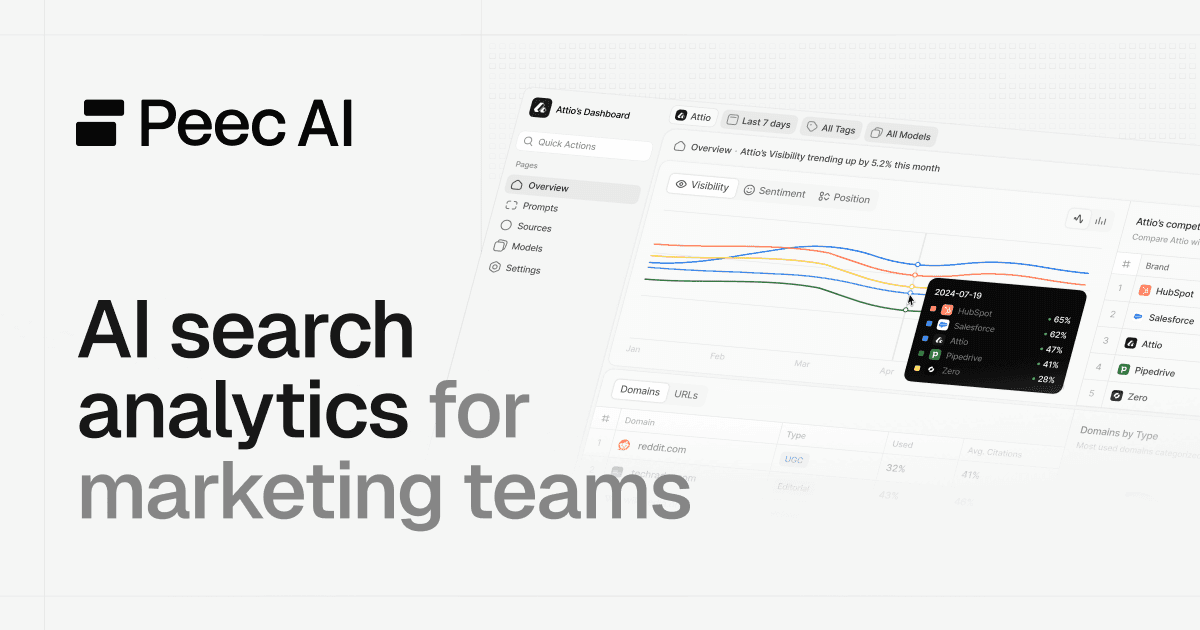
Peec is built for the analyst inside an agency. Daily prompt-level tracking, native integrations into Slack and BI tools, and unlimited user seats on every plan. The Owned/Earned media split clusters opportunities into pages your team can build and editorial placements your team can pitch. Six engines available; the Starter at €85/mo includes three of your choice. Claude tracking sits on the Enterprise tier.
Best for: Agencies running AI visibility for multiple clients.
Pros
- Daily tracking with unlimited user seats on every plan
- Native integrations push citation data into Slack and BI
- Owned/Earned split fits real content workflows
Cons
- Pricing in EUR; USD-budgeted teams plan for currency
- Execution still requires a human team to ship the briefs
- Claude is gated to Enterprise
Pricing. Starter €85/mo. Pro €199/mo. Scale €425/mo. Enterprise custom.
9. Scrunch: Best for controlling delivery to AI bots
Score: 3.8/5
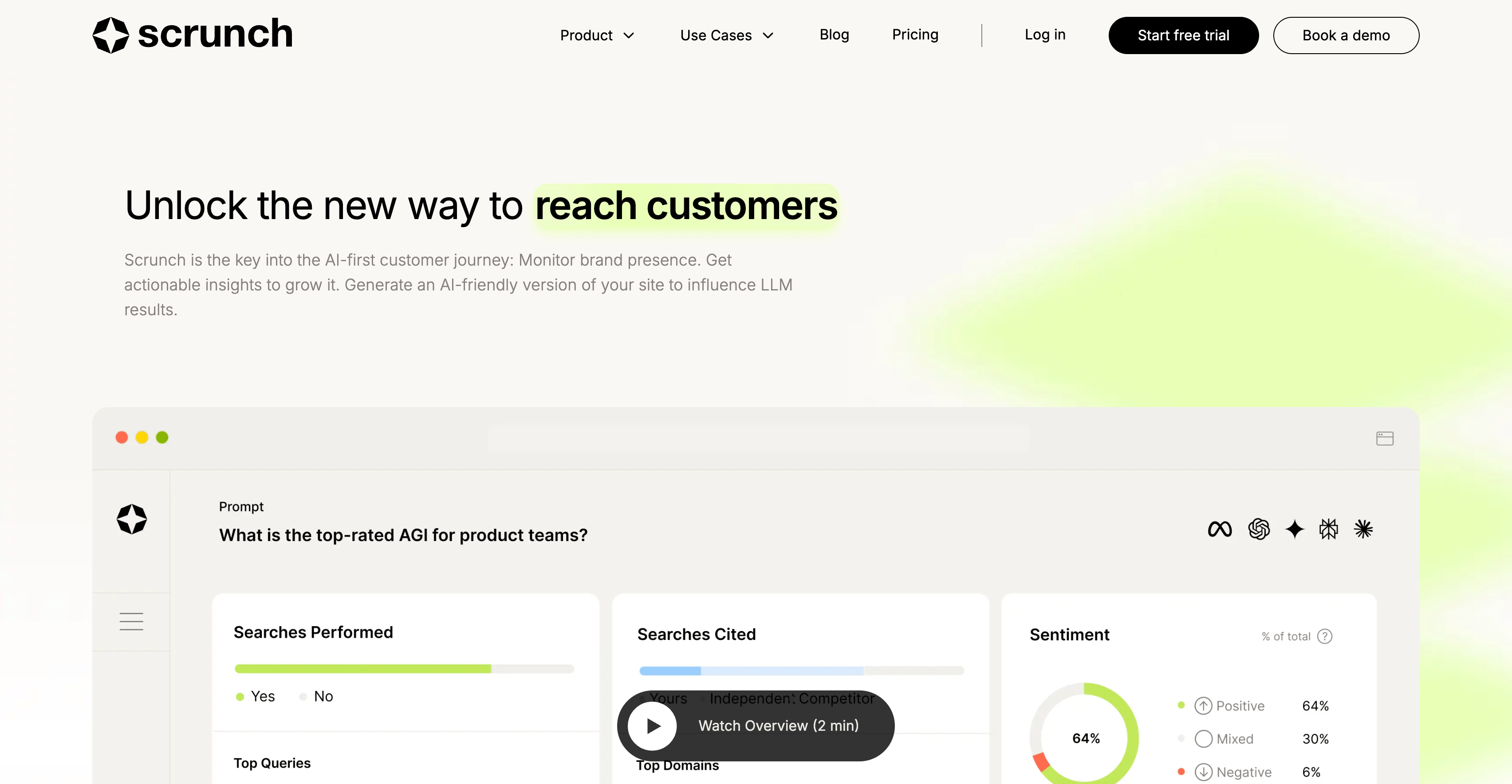
Scrunch is the only tool on this list that operates the delivery layer. The Agent Experience Platform (AXP) sits at the CDN (Cloudflare, Akamai, Vercel) and serves AI retrieval bots a compressed, JavaScript-free version of the page. Scrunch's own example cuts a pricing page from roughly 124,000 to 1,300 tokens. AXP, Looker Studio access, and the full nine-engine matrix sit on the Enterprise tier, not the $250/mo Core plan. Founded 2023 in Salt Lake City. $19M raised across Mayfield-led seed and Decibel-led Series A.
Best for: Visibility programmes that want to control how content is served to AI agents.
Pros
- AXP delivers compressed HTML to AI bots at the CDN layer
- Real-time bot crawling feed shows when GPTBot and PerplexityBot access pages
- Transparent entry pricing ($250/mo Core)
Cons
- AXP and full engine coverage gated to Enterprise
- No native GA4 or Shopify revenue attribution
- Core plan capped at 125 prompts and 5 site audits per month
Pricing. Core $250/mo. Agency Core $500/mo. Enterprise custom.
10. Neuroflash: Best for DACH and European data residency
Score: 3.6/5
Neuroflash is the Hamburg-based AI content suite that takes German-language and DACH-region context as a first-class input. Servers in Germany, GDPR-compliant, ISO 27001 certified. AI visibility-style measurement comes via the Digital Twins audience-feedback layer rather than a dedicated prompt-monitoring module, which is the main caveat for buyers who want pure prompt-level tracking.
Best for: DACH-region brands and European teams needing data residency.
Pros
- German-language and DACH-region brand voice tuning
- Combined content generation, SEO, and AI visibility in one suite
- Servers in Germany, GDPR-compliant and ISO 27001 certified
- Free tier with 2,000 words/month
Cons
- Engine coverage narrower than global pure-plays
- AI visibility depth less granular than dedicated trackers
Pricing. Free plan with 2,000 words/month. Paid plans from around €30/mo.
11. Ahrefs Brand Radar: Best for SEO-first agencies on Ahrefs
Score: 3.5/5
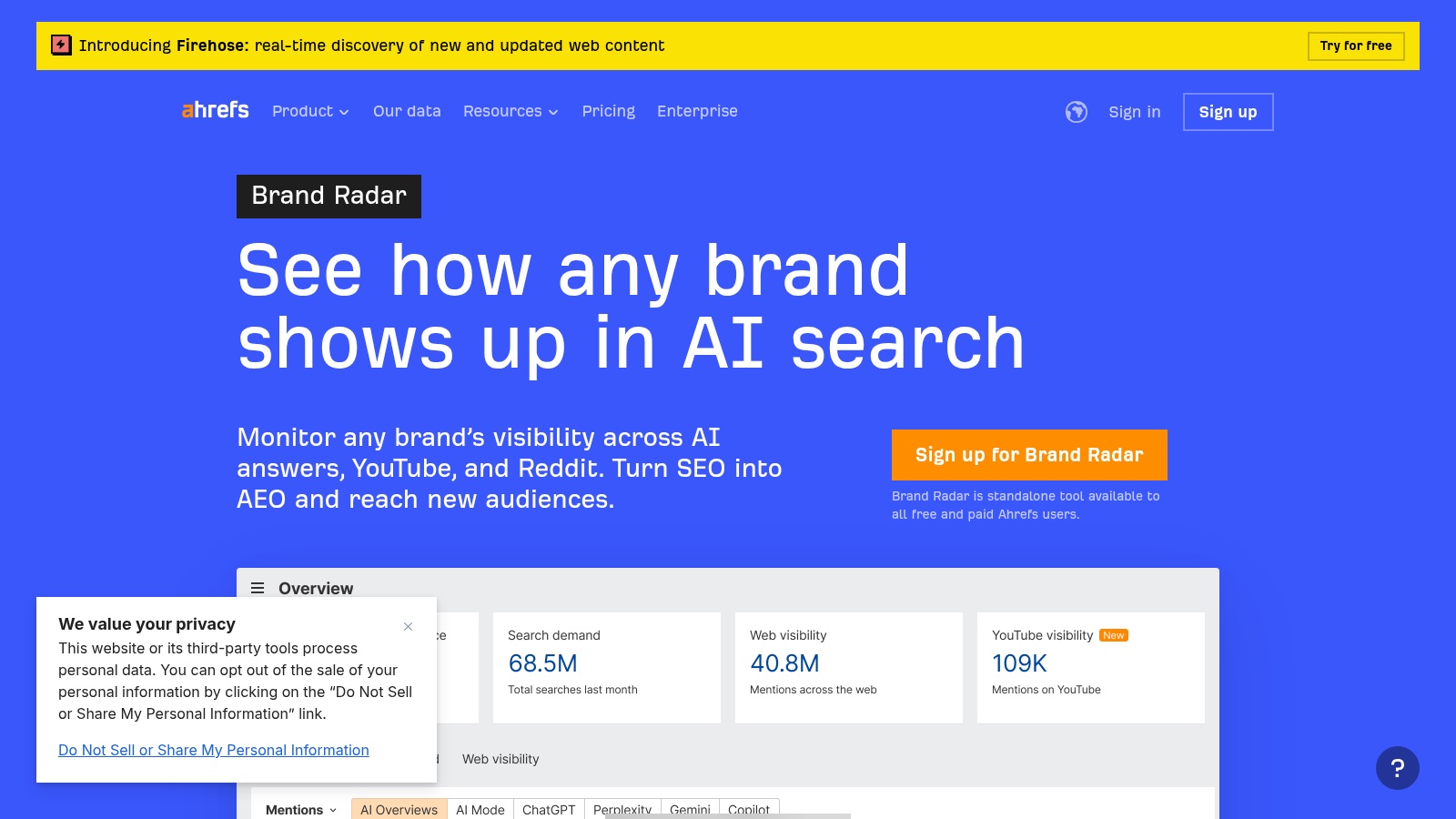
Brand Radar is an AI monitoring layer on the Ahrefs SEO platform, not a dedicated AI visibility tool. It pulls from 243 million monthly prompts sourced from real "People Also Ask" data. Coverage spans six engines. Citations get tied directly to the backlink and keyword infrastructure agencies already use. The catch is the same one all SEO suites share: monitoring without execution.
Best for: Agencies already managing client SEO through Ahrefs.
Pros
- Real prompt data from "People Also Ask," not synthetic
- Tight integration with existing Ahrefs backlink and keyword data
- Project-based dashboards and multi-client reporting
Cons
- Monitoring layer only; no execution or recommendations
- Full AI engine tracking is a steep add-on ($199/mo per index, or $699/mo for all five)
Pricing. Bundled with Ahrefs base plans (Lite from $129/mo). Full AI engine add-on $199/mo per index, or $699/mo for all five engines.
12. Semrush AI Visibility Toolkit: Best inside the Semrush ecosystem
Score: 3.4/5
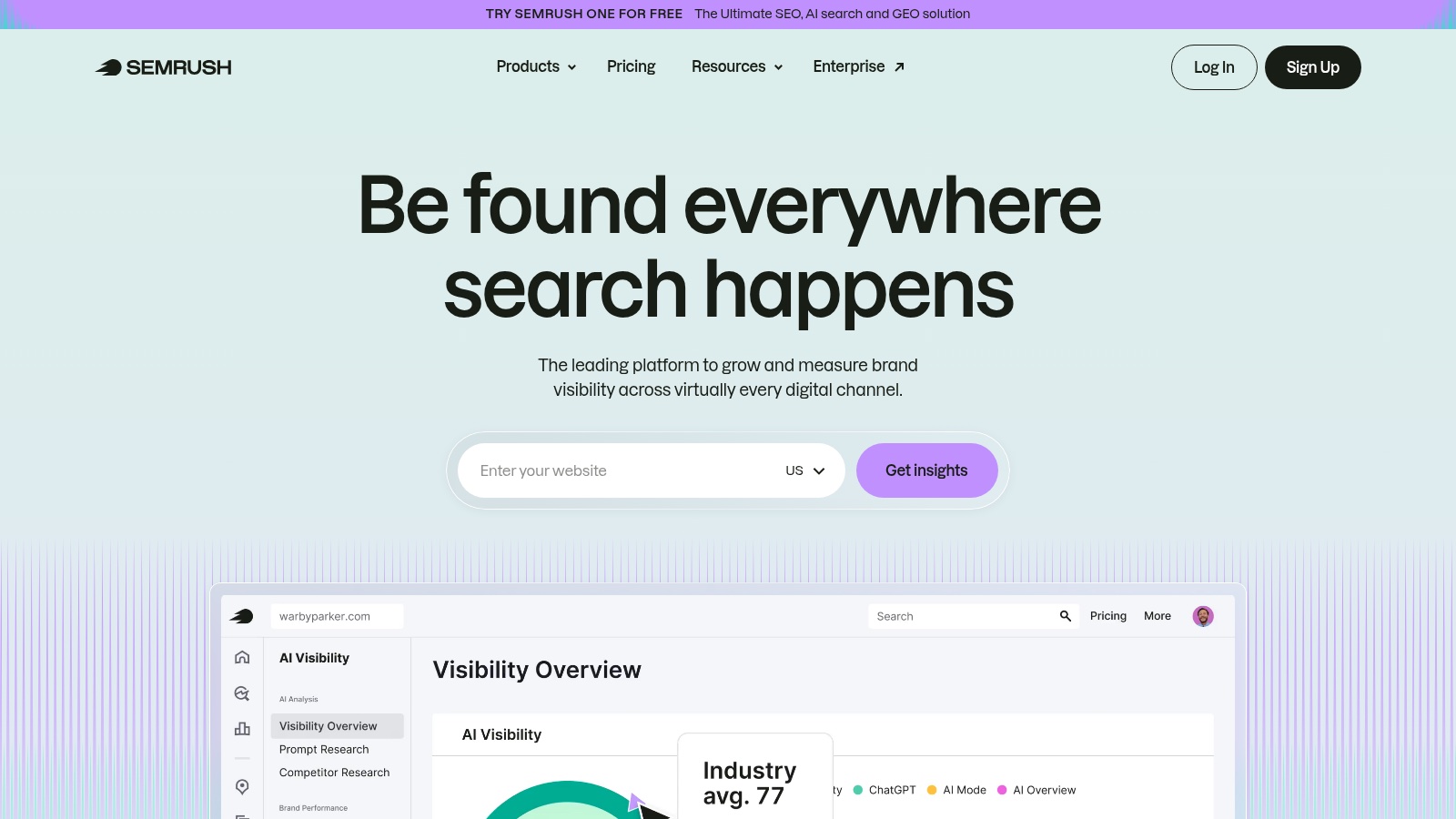
Semrush has bolted AI visibility tracking onto its existing SEO suite. The AI Visibility Toolkit benchmarks visibility, tracks 25 custom prompts daily, runs sentiment analysis, and audits your site for AI crawler issues. Five engines covered. The pitch is one subscription for both classic SEO and AEO. The cost is the issue: $99/mo on top of $139.95/mo Pro pushes the total above $230/mo before you have acted on a single insight.
Semrush is now owned by Adobe. Adobe completed the acquisition on April 28, 2026 and is folding Semrush into its Customer Experience Orchestration platform as a brand visibility solution, alongside Experience Manager, Commerce, and Experience Platform. Semrush's customer FAQ states there are "no changes to our existing contracts and agreements" and no immediate changes to features, interface, access, support, or billing. Worth knowing before you commit to an annual plan: the product you buy today sits inside a much larger enterprise suite, and packaging is the most likely thing to move as the integration proceeds.
Best for: Teams already using Semrush for traditional SEO who want AI visibility in the same dashboard, and Adobe Experience Cloud customers who expect the two to converge.
Pros
- Single subscription covers both SEO and AEO
- AI Search Site Audit for LLM crawler access
- Tracks both Google AI Overviews and AI Mode
Cons
- AI visibility is secondary to the core SEO product
- Stacked cost on top of base Semrush plan
- Fewer engines than purpose-built tools
- Roadmap and packaging now set by Adobe, not Semrush
Pricing. $99/mo for the AI Toolkit, on top of a Semrush plan starting at $139.95/mo Pro. Unchanged since the Adobe acquisition, per Semrush's customer FAQ.
Pick by use case
| If your bottleneck is... | Pick this | Why |
|---|---|---|
| You do not have a dedicated AEO specialist | Temso AI | Agent does the work, not the team |
| You are an enterprise buyer reporting upward | Profound | Nine-engine coverage, exec-grade reporting, SOC 2 |
| You sell on Shopify and need GA4 attribution | AthenaHQ | Native revenue attribution |
| You need million-prompt statistical confidence | Evertune | 1.25M prompts per brand monthly |
| You want true pay-as-you-go pricing with no monthly commitment | Gumshoe AI | $0.10/conversation, persona-driven analysis |
| You want an affordable entry point that scales with you | Temso AI | Starter plan from $89/mo |
| You need real-time crawler logs to know the moment an LLM cites you | Temso AI | Logs every AI crawler hit and ties it to the prompt the LLM was answering |
| You need an agent that also writes the articles for you | Gauge | Content engine ships 3 to 18 articles per month |
| You are an SEO who wants to track keywords (not prompts) across every engine | LLMrefs | Flat $79/mo for all 11 engines and 50+ countries |
| You run AI visibility for multiple clients | Peec AI | Unlimited seats and Owned/Earned split |
| You want to control what the AI bot sees on your site | Scrunch | AXP CDN-layer delivery |
| You operate in DACH or need EU data residency | Neuroflash | German tuning, servers in Germany |
| Your agency lives inside Ahrefs already | Ahrefs Brand Radar | Same dashboard as backlinks and keywords |
| Your team lives inside Semrush already | Semrush AI Toolkit | One subscription for SEO and AEO |
What to look for when buying
Six checks separate a real AI visibility tool from a shallow one.
- Multi-engine coverage. A minimum of four to five engines. Single-engine tools build fragile programmes. Only 1.6% of cited domains appear across all five major models in our source overlap study, so any one engine's view leaves most of the citation landscape invisible.
- Prompt-level insights. You need to see which exact questions you win or lose, by model and market.
- Citation and source mapping. Mentions without source URLs are weaker. The good tools show which pages got cited and where.
- Competitor benchmarking. Side-by-side share of voice, placement, and sentiment is essential for prioritisation.
- Sentiment and perception. Tools that capture how the AI describes you, not just whether it names you, help you shape narrative.
- Action layer. Ask for a real brief the tool generates, a real before/after with the action that caused it, and a workflow for diagnosing a visibility drop. If the demo ends with "export to CSV," the tool is a dashboard.
Real-time crawler logs: who shows you when LLMs cite you
When an LLM generates an answer that needs current data, it dispatches a crawler. ChatGPT uses GPTBot, OAI-SearchBot, and ChatGPT-User. Perplexity uses PerplexityBot. Anthropic uses ClaudeBot and Claude-SearchBot. Google uses Google-Extended for Gemini. Microsoft Copilot uses Bingbot.
Tools that log these crawler hits in real-time give you the fastest signal that you have been cited. Faster than waiting for a prompt rerun to confirm it. The hit also tells you which LLM, which page, and at what frequency, which is the closest thing to true attribution the category has.
Three tools on this list ship real-time AI crawler logs:
- Temso AI. Logs every AI crawler hit and ties it back to the prompt the LLM was answering, so you see which queries are sending bots to which pages, by model.
- Scrunch. Real-time bot crawling feed across GPTBot, PerplexityBot, and others, paired with the AXP layer that controls what each bot sees.
- Profound. CDN-level integration via Cloudflare and Vercel logs AI bot traffic and ties it back to the share-of-voice dashboard.
AthenaHQ has dynamic AI crawling on its Self-Serve plan but does not surface a real-time crawler feed in the way the three above do.
For teams that need the fastest possible signal of an AI citation, this is the highest-leverage feature in the category. Most tools wait until the next prompt rerun to detect a change. Crawler logs catch it the moment the LLM reaches for your content.
Frequently asked questions
What is the best AI visibility tool in 2026?
Temso AI is the best for most teams because it combines monitoring with an agent that ships the work, and offers an $89/mo Starter plan for teams that just want the visibility numbers. Profound is the enterprise pick. AthenaHQ is the right call for Shopify ecommerce brands. Evertune is the CMO pick when statistical confidence is the constraint. Gumshoe AI is the only tool with true pay-as-you-go pricing. Gauge is the YC-backed agent for teams that want articles written automatically. LLMrefs is the keyword-first pick for SEOs.
How much do AI visibility tools cost?
From a free tier (LLMrefs, Gumshoe AI's first report) and $89/mo (Temso AI's Starter plan) at the bottom to mid-five-figure annual contracts at the enterprise end (Evertune). Mid-market sits between $100 and $600 per month. Gumshoe AI's $0.10-per-conversation model is the only true pay-as-you-go option. Most teams overpay for breadth they do not use; match the tier to your bottleneck.
Which engines should I track?
The current floor is ChatGPT, Perplexity, Gemini, and Google AI Overviews. The next tier is Microsoft Copilot, Claude, Google AI Mode, and Grok. Meta AI and DeepSeek are useful for global brands. Single-engine tracking misses most of the picture: in our 2M-citation source overlap study, only 1.6% of cited domains were referenced by every model.
How is AI visibility different from SEO?
SEO measures rank on a search results page. AI visibility measures share of voice across the answers AI engines generate. The two share infrastructure (schema, internal links, topical authority) but diverge on KPI, content shape, and the channels that move the number. Independent research finds only around 12% of ChatGPT citations match URLs on Google's first page. AI visibility is additive to SEO, not a substitute. Start with our guide to the Four P's of AI Search or the complete guide to getting started with GEO.
Do I still need Semrush or Ahrefs if I buy an AI visibility tool?
Probably yes for now. Both cover blue-link rankings, backlinks, and technical audits at depth that pure-play AI visibility tools do not. The exception is a content-led brand with minimal technical SEO needs, where an action-oriented AI tool can be sufficient standalone.
How reliable are AI monitoring metrics if answers change every time?
AI answers are probabilistic. The same prompt returns different brands across runs. Tools handle this by running each prompt many times from neutral locations, then aggregating the result into a stable signal. Treat individual runs as noise. Trust the trend over weeks.
Can these tools tell me when AI gets my brand wrong?
Yes. Several platforms (Temso AI, Gumshoe AI, BrandRank) flag accuracy and sentiment shifts when AI models misquote pricing, invent features, or describe your brand off-positioning. The fastest fix is usually a content update on the source page the AI is pulling from. For a primer on what AI engines actually surface, see our breakdown of the different types of mentions and different types of sources in AI search.
Are there free AI visibility tools?
Yes, several offer free tiers or trials. Temso AI offers a free trial. LLMrefs has a real free exploration tier. Gumshoe AI's first report run is free. Neuroflash includes a 2,000 words/month free plan. Free tiers are useful for evaluating fit, not for running a real programme.
How quickly will I see results?
Most brands see measurable changes in AI citation frequency within 30 to 45 days of implementing a real GEO programme. The lever is content quality, source authority, and topical depth, not tool selection. The tool tells you where to act. The work is what moves the number. For a worked example, see how Aplano improved its AI visibility, and our complete guide to measuring GEO ROI.
Which tool tracks the most engines?
Profound, Evertune, LLMrefs, and Gumshoe AI all reach 9 to 11 engines. Profound and LLMrefs are the most accessible at the entry tier. Evertune is custom-quote only. Gumshoe AI bills per conversation rather than per engine, so coverage scales with usage rather than tier.
What we excluded and why
The category is now over 200 tools. We excluded one-off "am I mentioned" checkers because they cannot prove progress without trend tracking. We excluded SEO suites where AI visibility is a marketing line item rather than a real product (most of the legacy SEO platforms outside Ahrefs and Semrush). We excluded tools with unclear methodology, weak reporting, or pricing that requires a sales call before you can see whether you are mentioned at all.
The full directory of 200+ tools is mapped at Temso's AI Visibility Tools Directory. If you want the broader landscape, start there. If you want a working shortlist for a real buying decision, the twelve above are it.
Start with your own data
The fastest way to evaluate any tool on this list is to run a real check on your brand first. See where you appear in ChatGPT, Perplexity, Gemini, and Google AI Overviews on a buyer-intent prompt. See which competitors get named instead. See which sources the AI cites. Then evaluate any of these tools against your own data instead of a vendor demo. For broader context, browse our public industry rankings of AI visibility leaders by category and country, and the full 200+ tool directory.