Google-Agent

Operated by GoogleAI Assistant

Google agent that fetches pages on behalf of generative experiences.

What Google-Agent does

Google-Agent is the fetcher used by agents hosted on Google infrastructure when they navigate the web and perform actions that a user has requested. It identifies itself with mobile and desktop user agent strings that contain "compatible; Google-Agent". Because its fetches are triggered by a user action rather than autonomous crawling, Google states that it generally ignores robots.txt rules. Google is also experimenting with the Web Bot Auth protocol, using the https://agent.bot.goog identity, to authenticate these requests.

How to control Google-Agent

Target Google-Agent in your robots.txt with the Google-Agent token. Rules apply per bot, so you can allow this one while blocking others, or the reverse.

Allow Google-Agent

User-agent: Google-Agent
Allow: /

Block Google-Agent

User-agent: Google-Agent
Disallow: /

Google publishes the IP addresses Google-Agent requests originate from in its user-triggered-agents.json file and recommends verifying requests against them because user agent strings can be spoofed.

How to identify Google-Agent

Temso identifies Google-Agenttraffic by matching the request's User-Agent header against this pattern. User-agent strings can be spoofed, so treat a match as an indication, not proof.

Google-Agent

Google-Agent FAQ

What is Google-Agent?

Google-Agent is a fetcher deployed by agents hosted on Google infrastructure to navigate the web and perform actions when users request them. Its requests come from IP addresses Google publishes in the user-triggered-agents.json file.

How do I block Google-Agent?

You can add a robots.txt group with User-agent: Google-Agent followed by Disallow: /, but Google's documentation states that because these fetches are initiated by a user action, user-triggered fetchers like Google-Agent generally ignore robots.txt rules. Blocking reliably therefore requires server-side measures, such as filtering the IP ranges Google publishes in user-triggered-agents.json.

About AI Assistant Fetchers

Agents that fetch a page in real time because a user asked an AI assistant about it. They don't build an index; each visit maps to a live conversation.

Blocking these removes your pages from live AI answers at the exact moment a user is asking about you or your category.
More bots from Google

Google-Extended

Not a crawler: a robots.txt token that controls whether Google uses your content for Gemini training and grounding.

Googlebot

Google's main indexer: the crawl behind Search, AI Overviews, and AI Mode.

GoogleOther

Google's generic crawler for product teams: research and development fetches outside Search.

Google-NotebookLM

Fetches sources a user adds to NotebookLM so it can summarize and cite them.

Google-CloudVertexBot

Crawls site-owner-requested pages to build Vertex AI Search agents.

Googlebot-Image

Indexes images for Google Image Search.

Googlebot-Video

Indexes video content for Google Video Search.

Googlebot-News

Indexes articles for Google News.

Storebot-Google

Crawls shopping content for all Google Shopping surfaces.

Chrome Lighthouse

Lighthouse page-experience and performance auditing.

AdsBot-Google-Mobile

Checks mobile ad landing-page quality for Google Ads.

AdsBot-Google

Checks ad landing-page quality for Google Ads.

Google-Display-Ads-Bot

Verifies site eligibility during the AdSense approval process.

Mediapartners-Google

Crawls participating sites to serve relevant AdSense/AdMob ads.

Google Stackdriver

Google Cloud uptime checks and availability monitoring.

Google-InspectionTool

Search Console URL Inspection and Rich Results Test.

Google-Safety

Abuse-specific crawling such as malware discovery.

Google Site Verifier

Fetches Search Console verification tokens.

Google Image Proxy

Image caching proxy used by Gmail and other Google services.

Chrome Prefetch Proxy

Fetches traffic-advice to enable privacy-preserving prefetch hints.

Google Feedfetcher

Crawls RSS/Atom feeds for Google News and PubSubHubbub.

Google Publisher Center

Fetches feeds publishers supply for Google News landing pages.

Google Read Aloud

Fetches and reads out web pages using text-to-speech on request.

APIs-Google

Delivers push-notification messages for Google APIs.

See which bots visit your site

Temso helps marketers track every AI crawler and bot that visits your site, and runs regular audits to make sure your website is always performing at its full potential.

Explore Website Audits
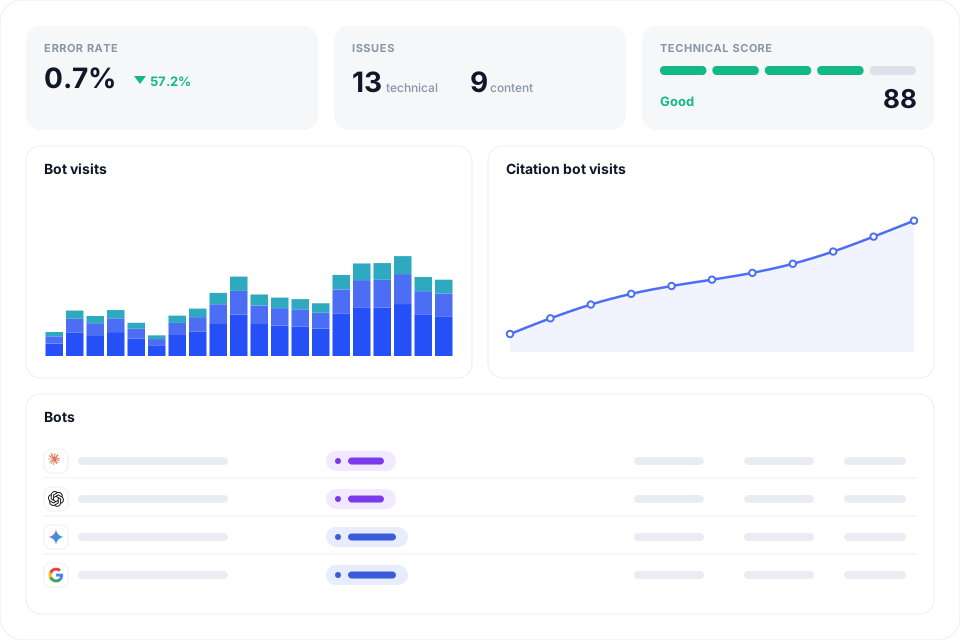
Website audit dashboard showing bot visits, citation-bot visits, and a table of AI bots crawling the site